Ireland's Air Quality Is Generally Good, Benefitting People's Health
Date released: October 21, 2026
Ireland's Air Quality Is Generally Good, Benefitting People's Health
Continued Progress Needed to Achieve Stricter 2030 Limits
- Air quality in Ireland is good, meeting air quality limits for 2025 and with pollutants decreasing over the last 20 years.
- When air pollution occurs, it causes significant health impacts. Despite meeting EU air quality limits, there are around 1,500 premature deaths a year linked to air pollution.
- Local authorities continue to play a key role in maintaining and supporting cleaner air including enforcing compliance with solid fuel regulations which ban the sale of smoky fuels, promoting retrofitting and delivering active travel infrastructure for communities.
The EPA has published its report, Air Quality in Ireland 2025, which is based on data from Ireland’s extensive air monitoring network of 113 stations. It reveals that air quality in Ireland is good, it currently meets EU air quality limits and highlights how pollutants have decreased over the last twenty years. This benefits people’s health and the environment.
Continued progress in implementing measures such as the enforcement of solid fuel regulations which ban the sale of smoky fuels, promotion of home retrofitting, support for active travel, and public awareness initiatives will enable Ireland to further improve air quality and meet the stricter 2030 EU requirements.
Air pollution in Ireland is not confined to larger cities. Communities in towns and villages can also be negatively affected by pollutants from solid fuel burning and traffic emissions. The EPA website provides hourly real-time information on local air quality and the new Air Quality Index for Health (AQIH) links general health advice to monitored air quality. This valuable resource informs citizens on the steps they can take to protect their health during periods of poor air quality.
Despite Ireland’s relatively good air quality, air pollution from solid fuel burning and traffic emissions still causes significant health impacts. The European Environment Agency estimates that, in Ireland, about 1,500 premature deaths annually are attributable to air pollution. To deliver cleaner air and improved public health, Government support for infrastructure, household measures such as cleaner heating and home retrofit grants, and enforcement activities must be maintained and strengthened.
Pat Byrne, Director of the EPA’s Office of Radiation Protection and Environmental Monitoring, stated:
“Continued improvement in air quality is possible with practical local action and sustained investment in supporting cleaner heating, promoting home energy retrofitting, improving public transport and encouraging active travel. By focusing support on communities most affected by air pollution, we can reduce health risks, improve quality of life and ensure healthier futures for those communities.”
Local authorities play a vital role in improving air quality through the enforcement of solid fuel regulations, promoting home retrofitting, promotion of active travel, and public awareness initiatives.
Warren Phelan, EPA Programme Manager for Environmental Monitoring and Surveillance, added:
“Clean air is essential for good health, and Ireland's air quality is generally good. Continued progress will require commitment from government, local authorities, businesses and communities to protect and further improve the air we breathe. By working together, we can reduce exposure to air pollution, improve quality of life, and create healthier places to live and work.”
The Air Quality in Ireland 2025 report is available on the EPA website.
ENDS
Contact:
EPA Media Relations Office 053-91 70770 (24 hours) media@epa.ie
Notes to Editor
Ambient air pollution: Ambient (outdoor) air pollution is recognised as a major environmental risk to health internationally. According to the World Health Organization (WHO), ambient air pollution accounted for an estimated 4.2 million premature deaths in 2019 worldwide - due to stroke, heart disease, lung cancer and chronic respiratory diseases, such as asthma. In children and adults, both short-term and long-term exposure to ambient air pollution can lead to reduced lung function, respiratory infections and aggravated asthma. Read more on the WHO website.
The European Environment Agency (EEA) has estimated that there are approximately 1,500 premature deaths annually in Ireland due to poor air quality from fine particulate matter (PM2.5). See Europe's Air Quality Status 2026.
To find out more about how we can improve air quality read the EPA’s ‘How we can improve the air we breathe’ infographic or check out the Government of Ireland website which highlights some simple steps we can all make and help reduce pollution from solid fuels.
Existing and Future Targets
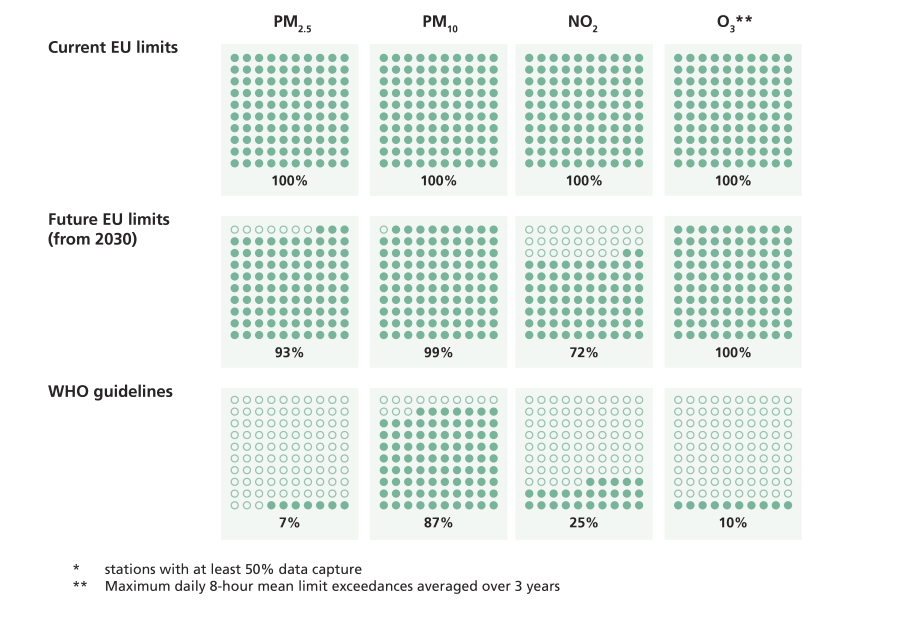
The report data highlights the improvements in air quality in Ireland over time with most pollutants showing a steady decline. Despite this, Ireland has progress to make to achieve the new pollutant limits for 2030 required under the EU Ambient Air Quality Directive and the longer-term recommendations of the World Health Organisation. Table 1 shows the level of compliance with existing and future targets for key atmospheric pollutants.
Table 1: Percentage of monitoring stations in 2025 in Ireland achieving annual average limit/guideline values*.
National Ambient Air Quality Monitoring Programme: The EPA, working with local authorities and other public bodies, has established 113 air monitoring stations. The EPA continually monitors air quality across Ireland and provides the air quality index for health and real-time results online. Monitoring data is available online providing up to date information on air quality across Ireland.
Results are updated hourly on the website, and people can log on at any time to check whether the current air quality is good, fair or poor. The data is also used to inform national policy and meet Ireland’s commitments to European reporting.
Key Pollutants and Sources:
PM2.5 (Fine Particulate Matter): These microscopic particles, primarily from solid fuel burning in homes, can penetrate deep into the lungs and bloodstream, causing serious health issues. Cities, towns and villages are especially affected.
Nitrogen Dioxide (NO₂): Mainly from diesel and petrol vehicles, NO₂ harms respiratory and cardiovascular health and contributes to acid rain and ozone formation.
Online Air Quality Forecasting
Updated hourly and annual high-resolution maps and daily forecast models are available online. These online resources enable the public to make more informed health related decisions on a daily basis. The models fill in gaps between monitoring stations.
The EPA is also supporting citizen science projects on air quality such as the GLOBE project and Clean Air Together (CAT). This is done to create a better understanding of NO2 air pollution. After successful campaigns in Dublin and then Cork in 2022, Clean Air Together moved to Galway for 2023 and Limerick for 2024. Clean Air Together in Waterford City was completed in March, 2026. See Clean Air Together (CAT).