Evidence Synthesis Report 15: Doughnut Economics: A Framework for the Sustainable Development of Ireland’s Bioeconomy
Authors: Luke Kelleher, J. Andrew Kelly, Eoin O’Neill, Hannah Gould, Yanika Farrugia, Angela Milimu, Vishwajeet Pundkar and Nimisha Setia
Summary: This research study, led by EnvEcon Decision Support and University College Dublin examines the potential of the Doughnut Economics framework to support the sustainable development and monitoring of Ireland’s bioeconomy. Doughnut Economics is a conceptual framework that defines a space for sustainable development between two boundaries: a social foundation and an ecological ceiling. The research found that that Doughnut Economics would be most valuable as an organising and decision-support framework rather than a stand-alone monitoring system. It could help collate existing indicators, priorities and trade-offs into a single structure, making system interactions, gaps and trade-offs more visible for policy discussion and decision-making. The research recommends that effective implementation would require clear governance, institutional ownership, defined users and alignment with existing monitoring initiatives and observatory work. A staged approach
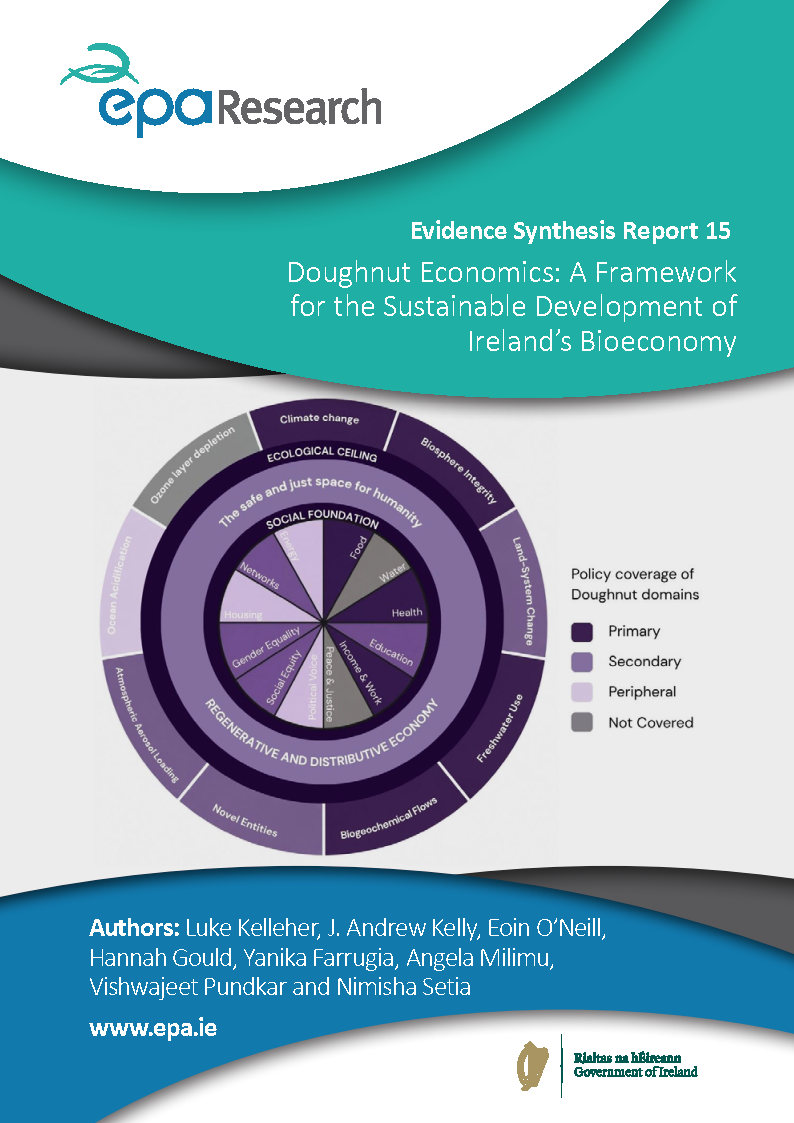
The latest report published by the EPA under its Fast-Track to Policy Scheme Evidence synthesis report 15: Doughnut Economics: A Framework for the Sustainable Development of Ireland’s Bioeconomy led by EnvEcon Decision Support and University College Dublin examines the potential of the Doughnut Economics framework to support the sustainable development and monitoring of Ireland’s bioeconomy.
Doughnut Economics is a conceptual framework that defines a space for sustainable development between two boundaries: a social foundation and an ecological ceiling.
The research found that that Doughnut Economics would be most valuable as an organising and decision-support framework rather than a stand-alone monitoring system. It could help collate existing indicators, priorities and trade-offs into a single structure, making system interactions, gaps and trade-offs more visible for policy discussion and decision-making.
This report was carried out under the EPA’s Fast Track to Policy scheme, which supports the rapid generation of evidence to inform the design and implementation of effective and robust environmental policy.
https://www.epa.ie/media/epa-2020/publications/Evidence-Synthesis-Report-15-cover-thumbnail.jpg