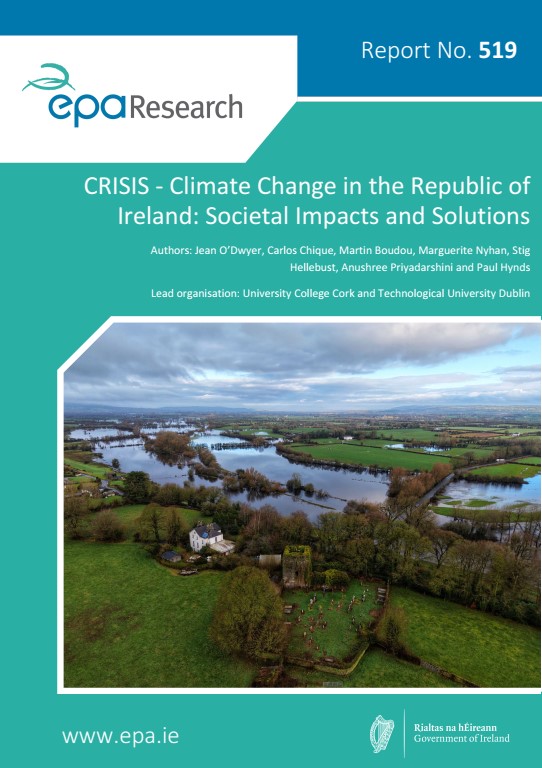
Research 519: CRISIS – Climate Change in the Republic of Ireland: Societal Impacts and Solutions
Authors: Jean O’Dwyer, Carlos Chique, Martin Boudou, Marguerite Nyhan, Stig Hellebust, Anushree Priyadarshini and Paul Hynds
Summary: Climate Change in the Republic of Ireland: Societal Impacts and Solutions, (CRISIS) led by UCC provides the first integrated assessment of the societal and public health impacts of climate change in Ireland. Using surveys, health data, spatial analysis and climate projections, the findings demonstrate how extreme weather events (EWEs) and changing climate patterns are already impacting health, with floods and heatwaves linked to increased waterborne diseases and negatively impacting mental well-being. Younger people, urban residents and socioeconomically disadvantaged groups reported the highest levels of stress. This research provides important Ireland-specific evidence to support climate-resilient public health policies. Findings can inform climate adaptation planning, disease surveillance, emergency preparedness, water quality management and targeted support for vulnerable communities, helping policymakers and public health agencies prepare for future climate-related health risks.
What did the research aim to address?
The CRISIS project aimed to address a critical knowledge gap regarding how climate change is impacting human health and wellbeing in Ireland, both now and in the future. While climate-related risks are well recognised globally, there has been limited integrated, Ireland-specific evidence linking extreme weather events (EWEs), environmental exposures, and public health outcomes. This research was therefore designed to generate a comprehensive, evidence-based understanding of these relationships to inform national policy and preparedness. The study is important for policymakers, public health professionals, environmental agencies, and vulnerable communities, as it identifies who is most at risk and why. It responds to growing concerns about increasing floods, heatwaves and droughts, and their implications for mental health, water quality, and infectious disease transmission. The project adopted an innovative, interdisciplinary approach, combining national survey data, epidemiological analysis, spatial modelling and climate projections. This integrated framework enabled the linking of environmental drivers with both physical and psychological health outcomes, while also projecting future risks. By combining multiple data sources and advanced analytical techniques, the research provides a robust evidence base to support climate-resilient public health strategies in Ireland.
What did the research find?
The CRISIS project found that climate change is already having measurable impacts on public health in Ireland, particularly through extreme weather events (EWEs), waterborne disease, and mental health. National survey results showed that EWEs significantly affect psychological wellbeing, with younger, urban and socioeconomically disadvantaged groups experiencing the highest stress levels. Epidemiological analyses identified clear links between flooding and increased cases of Verotoxigenic producing E. coli (VTEC) and Cryptosporidiosis, while the 2018 heatwave coincided with elevated infection rates and shifting disease patterns. These findings directly address the previous lack of integrated, Ireland-specific evidence by demonstrating how climate and health are interconnected across multiple pathways. The research is highly relevant for policymakers and public health stakeholders, supporting improved disease surveillance, climate adaptation planning, and targeted interventions for vulnerable populations. Engagement with governmental agencies (e.g. HSE) helped ensure policy relevance and uptake. The project advances current knowledge through its novel integration of survey data, spatial epidemiology, and climate modelling to project future health risks. However, some limitations include reliance on self-reported survey data and potential underrepresentation of vulnerable groups. Overall, the research provides a robust evidence base for climate-resilient public health policy in Ireland.
How can the research findings be used?
CRISIS provides a strong evidence base to support climate-resilient public health policy and practice in Ireland. Findings can be used by government departments, public health agencies, and local authorities to inform climate adaptation strategies, particularly in areas such as water quality management, disease surveillance, and emergency preparedness. For example, integrating climate data into early warning systems can help anticipate disease outbreaks following extreme weather events, while targeted mental health supports can be embedded within disaster response frameworks. Next steps include translating findings into actionable policy through cross-sector collaboration, strengthening monitoring systems, and investing in resilient infrastructure, particularly for vulnerable groups such as private well users. The research also supports the development of public awareness campaigns on safe water and food practices during extreme events. The work is already aligned with national climate and health policy priorities and offers opportunities for integration into future adaptation plans and risk assessments. However, further research is needed to refine predictive models, improve real-time data integration, and better capture impacts on underrepresented populations. Continued stakeholder engagement will be essential to ensure effective implementation and long-term environmental and public health outcomes.
https://www.epa.ie/media/epa-2020/publications/research/Cover-519.jpg