There is an urgent need for mandatory registration of private drinking water supplies, says EPA
Date released: July 22, 2025
- The total number of small private supplies remains unknown as there is no legal obligation to register. Unregistered supplies are not monitored by local authorities.
- Water quality in private water supplies is not as good as public water supplies.
- The number of private group schemes failing to meet the E. coli standard in 2024 was 24, up from 13 in 2022.
- 19 private group schemes failed to meet Trihalomethanes standards in 2024.
23rd July 2025: The Environmental Protection Agency (EPA) today released its Drinking Water Quality in Private Group Schemes and Small Private Supplies 2024 report.
Currently, over 370 private group schemes supply drinking water to 193,000 people across rural communities in Ireland. In addition, many businesses and public facilities supply water from their own private wells. These are called small private supplies.
There are almost 1,700 small private supplies registered with local authorities. However, many more are not registered. A gap in current drinking water legislation means the regulations do not require private suppliers to register. As a result, the total number of small private supplies in the country remains unknown. These include supplies serving schools, nursing homes, sports clubs and self-catering accommodations. The quality of water in unregistered supplies is not monitored by local authorities.
Launching the report, Micheál Lehane, EPA Director said:
"The lack of a mandatory requirement to register a private supply serving water to the public is a serious legislative gap that must be addressed. Without registration and subsequent monitoring by local authorities, consumers are unaware of the potential health risk they may be exposed to. Everyone has the right to safe drinking water. We want to see mandatory registration, but in the interim we strongly encourage private suppliers to register with local authorities so that all proper safety checks can be carried out on their supply.”
E. coli Compliance
Meeting E. coli standards is a minimum requirement in the provision of safe drinking water and failures indicate a lack of proper disinfection which must be addressed by water suppliers.
24 private group schemes failed to meet the E. coli standard in 2024, up from 13 in 2022. Six schemes had repeat failures over two consecutive years and five of these are on long-term boil water notices.
E. coli failures were recorded in 51 small private supplies that were monitored by local authorities, posing a risk to consumers that use these supplies.
Noel Byrne, Programme Manager of the EPA’s Office of Radiation Protection and Environmental Monitoring said:
“E. coli contamination of a drinking water supply can cause serious public health impacts. E. coli compliance has declined with almost double the number of private supplies failing in 2024 compared to 2022. This needs to be addressed as every community deserves access to safe, clean drinking water. Suppliers must take action to upgrade their systems and meet standards. Local authorities, as the regulator of private group schemes, need to take the necessary enforcement action to ensure public health is protected.”
Trihalomethanes (THM)
Trihalomethanes (THMs) can form when natural material like leaves or other organic matter in the water source, react with chlorine used to disinfect the drinking water. While disinfection is essential, THM levels should be kept as low as possible and in compliance with the drinking water standards.
In 2024, 19 private group schemes supplying 21,800 people failed the standard for Trihalomethanes (THMs). This shows little change from 2023 when 21 schemes supplying 22,000 people failed the standard. Greater effort is needed by these private group schemes to improve treatment systems and minimise exposure to THMs. Small private supplies do not have elevated THMs, as the vast majority of their water is sourced from groundwater wells, which lack the levels of organic matter required to form THMs.
The EPA report on Drinking Water Quality in Private Group Schemes and Small Private Supplies – 2024 is available on the EPA website.
Further information: Emily Williamson, EPA Media Relations Office 053-9170770 (24 hours) or media@epa.ie
Notes to Editor:
Some key findings of the 2024 report on private water supplies:
- Local authorities monitored 91 per cent (1,517) of the 1,663 registered SPS. This is an improvement from 86 per cent in 2023 and 75 per cent in 2022.
- The percentage of schemes fully compliant with the E. coli standards was as follows:
- Private group water schemes: 93.7 per cent. (24 of 379 – 6.3 per cent - failed to meet the standard).
- Small private supplies: 96.9 per cent. (51 of 1,663 – 3.1 per cent - failed to meet the standard).
- There is a downward trend in E. coli compliance in private group schemes from 13 schemes that failed the standard in 2022, to 24 schemes in 2024.
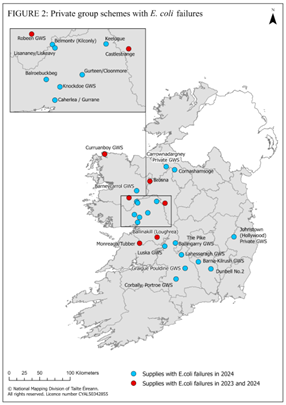
- The schemes that failed to meet the standard in 2024 are highlighted on the map below – Private Group Schemes with E. coli Failures.
- The map highlights 6 schemes that had repeat failures of the standard in 2023 and 2024.
- Nineteen private group schemes failed to meet the Trihalomethanes (THM) standard.
- Monitoring data is available at the following link: SAFER-Data: Welcome to SAFER (epa.ie)
Regulated and Exempt Private Water Supplies
Some private supplies are overseen by the local authority because they are covered by the Drinking Water Regulations. This makes them regulated supplies. Other supplies are not covered by the regulations; these are called exempt supplies. The table below shows which supplies are regulated and which are exempt.
| Type of Supply |
Number of people served or volume supplied |
Regulated or exempt? |
|---|---|---|
| Public Group Scheme or Private Water Group |
≥50 people or 10,000 litres per day |
Regulated |
| <50 people or 10,000 litres per day, not supplying any public/commercial activity | Exempt | |
| <50 people or 10,000 litres per day, but supplying a public/commercial activity | Regulated | |
| Small Private Supply | Supplying a public or commercial activity regardless of the number of people served or volume supplied | Regulated |
| Household well (also called private wells) | Single house only | Exempt |
Trihalomethanes
Trihalomethanes (THM) are a by-product of the chlorine disinfection process and are formed where there is an excess of organic matter in the water source. There is a legal limit of 100µg/l for THMs and water suppliers should aim to keep THM levels within the drinking water standards. In early 2024 the Court of Justice of the European Union ruled that Ireland had failed to fully implement the Drinking Water Directive in relation to THMs in drinking water. Actions to prevent THM failures need to be prioritised, to protect public health.