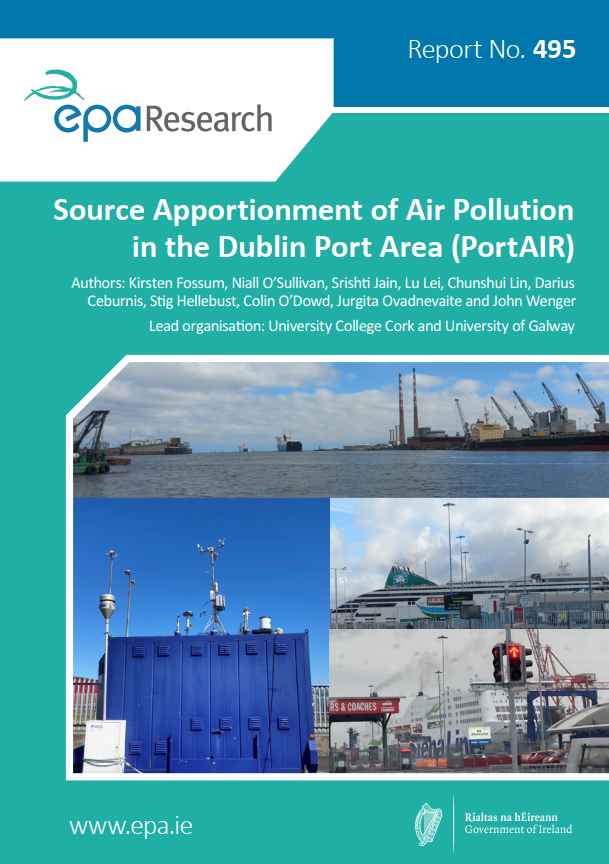
Research 495: Source Apportionment of Air Pollution in the Dublin Port Area (PortAIR)
Authors: Kirsten Fossum, Niall O’Sullivan, Srishti Jain, Lu Lei, Chunshui Lin, Darius Ceburnis, Stig Hellebust, Colin O’Dowd, Jurgita Ovadnevaite and John Wenger
Summary: Dublin Port, Ireland’s largest freight and passenger port, brings significant economic and social benefits, however emissions from ships and other port-related activities contribute to climate change and air pollution. The PortAIR project conducted the first detailed study of air quality impacts from ships and port activities using continuous monitoring and advanced modelling throughout 2022. It identified two main ship plumes: one dominated by sulfate from high-sulfur fuel with scrubbers and another by organic species from low-sulfur fuels. Ship emissions peaked during manoeuvring. With port expansion planned, emission reduction strategies are recommended, including shore-side electricity, emission control zones, battery-powered vessel and cleaner fuels. The study highlights the importance of advanced instruments for continuous air quality monitoring and recommends the need for further research into mitigation technologies.
What did this research aim to address?
Dublin Port is Ireland’s largest freight and passenger port, handling a significant portion of the country’s international trade and playing a crucial role in the national and regional economies. While the port brings significant economic and social benefits, the emissions from ships and other port-related activities contribute to climate change and air pollution, affecting the health of citizens and the environment. The principal objective of the PortAIR project was to conduct the first detailed study of the impact of ships and other pollution sources on air quality in the Dublin Port area. This was achieved through a combined measurement–analysis approach involving continuous monitoring of air pollution and the chemical composition of particulate matter (PM) throughout 2022, a multi-instrument intensive field campaign conducted during the height of shipping activity, and advanced source apportionment modelling methods. This innovative approach delivered new results on air pollution sources to enable Dublin Port Company and other stakeholders (Dublin City Council, the EPA, government departments) to develop targeted strategies for reducing emissions in Dublin Port.
What did this research find?
Hundreds of ship plumes were observed as discrete pollution events and categorised into two main types using known chemical markers. The first plume type contained PM dominated by sulfate, attributed to ships using high-sulfur heavy fuel oil and fitted with a scrubber system to reduce SO2 emissions. The second plume type contained PM dominated by organic species, attributed to ships using low-sulfur marine fuels. Ship emissions were at their highest while manoeuvring in and out of the berth, while smaller amounts of pollutants were emitted over a longer timescale when vessels were docked. The main sources of PM2.5 at the PortAIR site during 2022 were regional background (56%) and ship emissions (21%), with vehicles and home heating largely accounting for the remainder. Ship plumes were the main source of SO2 and contributed significantly to both submicron particle number concentration and NOx. While the prevailing westerly winds generally carried port-based emissions towards the Irish Sea, data obtained from an air sensor network showed that port emissions caused an increase of up to 6% in PM2.5 in parts of the city adjacent to the port.
How can the research findings be used?
The planned expansion of Dublin Port will lead to greater ship emissions, and it is therefore recommended that measures to reduce air pollution are introduced. The provision of shore-side electricity to vessels at berth has already been identified as a good way of reducing emissions and is specifically mentioned in the Dublin Port Masterplan. The introduction of a designated Emission Control Area for the North-East Atlantic region would control NOx emissions from ships and further reduce SO2 and particulate matter. The use of battery-powered ferries and small vessels are also worthy of consideration, along with switching to renewable or low-carbon fuels for ships. However, further research into the pros and cons of these approaches is required. This research clearly demonstrated the value of sophisticated research-grade instruments for online continuous monitoring of PM. It is recommended that future field measurement campaigns also utilise instruments for monitoring fine and ultrafine particle number concentration, as well as online elemental analysis to provide a more complete understanding of the sources and health impacts of ambient PM.
https://www.epa.ie/media/epa-2020/research/research-publications/Cover-495.png