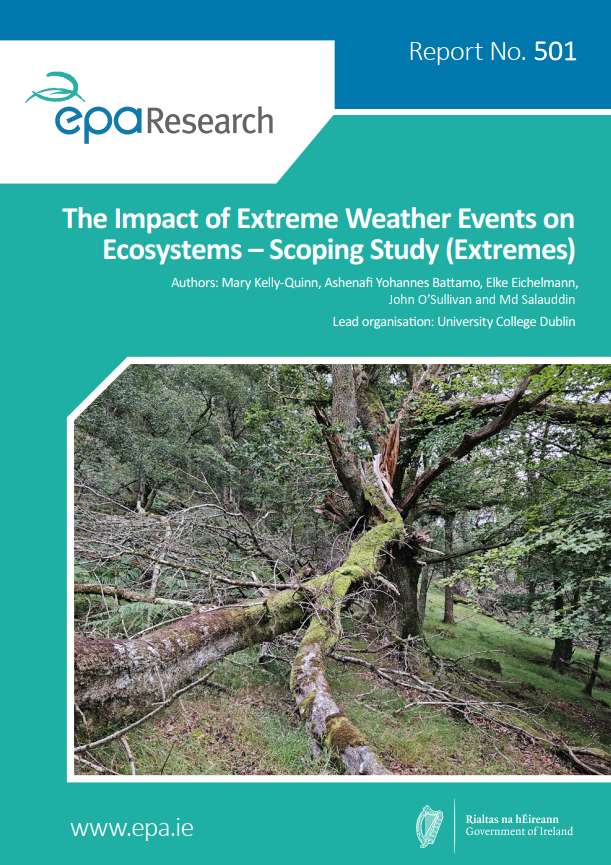
Research 501: The Impact of Extreme Weather Events on Ecosystems – Scoping Study (Extremes)
Authors: Mary Kelly-Quinn, Ashenafi Yohannes Battamo, Elke Eichelmann, John O’Sullivan and Md Salauddin
Summary: Evidence of accelerating pressures on ecosystems and biodiversity is mounting, particularly in terms of pollution and habitat fragmentation. This desk-study led by a team from UCD examined the potential impacts of extreme weather events (EWEs) on Ireland’s Special Areas of Conservation and Special Protection Areas. Stakeholder questionnaires highlighted habitat-specific vulnerabilities and varying sensitivities e.g., flooding and heavy rain threaten rivers and uplands; heatwaves affect lakes; droughts endanger fens and turloughs; and wildfires and storms damage forests and grasslands. A vulnerability framework combining exposure, sensitivity, and adaptive capacity tested on Dublin Bay’s Atlantic salt meadow showed potential for national application. Findings provide information to track climate change impacts and mitigate EWE impacts on protected sites It recommends targeted assessments, development of indicators, collection of multi-scale data, and enhancement of monitoring systems.
What did this research aim to address?
The overall aim of this scoping study was to identify the potential impacts of extreme weather events (EWEs) on Special Areas of Conservation (SACs) and Special Protection Areas (SPAs) in Ireland and inform research needs. The study initially carried out a literature review that synthesised the reported impacts of EWEs, as opposed to more gradual climate change, on the biota of aquatic and terrestrial habitats that present specific risks to SACs and SPAs. The review revealed that impacts are highly context specific and that few data are available on Irish habitats. Furthermore, it is difficult to attribute impacts to a specific event type. Additionally, the impact of EWEs is species dependent, with different species, even within the same taxon, showing divergent responses to the same event. Drawing generalised conclusions from the existing literature and extrapolating these to an Irish context is difficult.
What did this research find?
Potential impacts on SACs and SPAs in Ireland were further explored through a questionnaire circulated among stakeholders. Responses highlighted that EWEs have varying degrees of impact across habitat groupings. A list of EWEs cited as having the largest impact on different habitat groups was compiled. Intense precipitation and flooding were reported to be particularly detrimental to rivers, streams, heaths and upland rocky habitats. Short periods of high temperatures exceeding 25°C were found to severely affect lakes, pools and standing waters. Prolonged droughts emerged as a critical threat to fens and turloughs, whereas wildfires and storm-force winds were reported to heavily impact forests and woodlands. Grasslands were reported to be particularly vulnerable to wildfires, while estuarine and marine habitats were notably affected by prolonged cold spells. Coastal habitats were found to face pronounced risks from tidal surges. Sensitivity to these climatic stressors varied substantially depending on habitat type. These findings highlight the urgent need to prioritise specific SACs and SPAs for detailed assessment of EWE impacts, and to inform future conservation and further research.
How can the research findings be used?
We identified a vulnerability assessment framework, comprising exposure, sensitivity and adaptive capacity indices, and tested its applicability in a case study on an Atlantic salt meadow habitat in Dublin Bay. The assessment revealed significant variation in exposure and impact severity, as indicated by the calculated Extreme Vulnerability Index scores. The framework has the potential to be applied at the national level to generate a vulnerability heat map for the various habitat groupings within SACs and SPAs and for more site-specific investigations required for identification of impact mitigation measures. Research needs relate to the production of national vulnerability maps and the identification of appropriate and measurable indicators for the three components of the vulnerability assessment framework. This may require both observational and experimental data collection, taking a multi-stressor, multi-scale perspective. Research is also needed to develop a robust analytical framework to test whether routine monitoring data can be used to detect impacts of climate change and EWEs. Based on the outcome of this analysis, it may be possible to identify how these monitoring programmes can be augmented to address the additional information needs.
https://www.epa.ie/media/epa-2020/research/research-publications/Cover-501.png