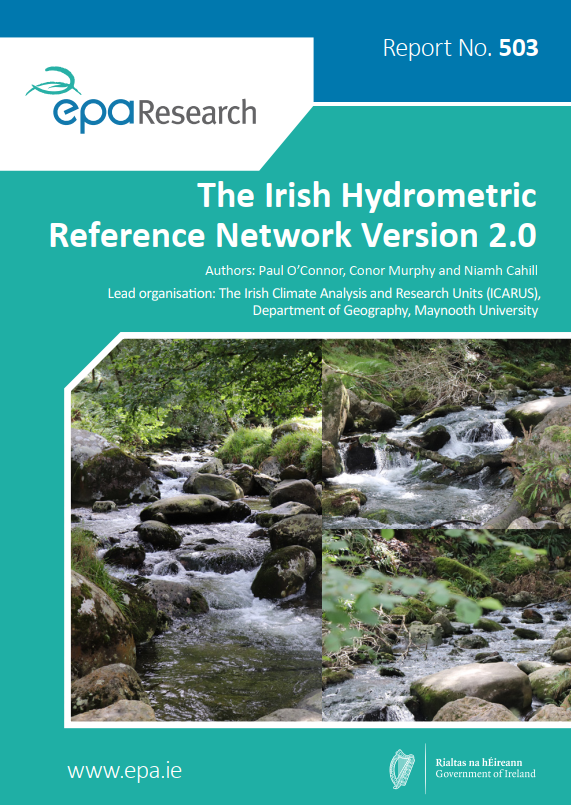
Research 503: The Irish Hydrometric Reference Network Version 2.0
Authors: Paul O’Connor, Conor Murphy and Niamh Cahill
Summary: Hydrometric reference networks are crucial for tracking climate variability, hydrological modelling and extreme events. This research, led by a team in Maynooth University, enhanced the Irish Hydrometric Reference Network (IHRN) to better detect climate-driven changes in river flows across Ireland. Building on the EPA HydroDetect project, it adds a key tool for water management and addresses gaps in understanding floods, average flows and droughts. Findings show increasing high and mean flows in winter and decreasing low flows in spring and summer indicating greater flood and drought risks. Long-term reconstructions show stronger seasonal trends and the influence of the North Atlantic Oscillation. The updated IHRN dataset underscores the importance of hydrological modelling, flood risk management and climate resilience planning. The research recommends expanding the network to include groundwater and lakes with coordinated national oversight to ensure Ireland’s hydrological resilience.
Project highlights video
What did this research aim to address?
The research aimed to update and expand the Irish Hydrometric Reference Network (IHRN) for monitoring and detecting climate-driven changes in river flows across the island of Ireland. Addressing a critical knowledge gap, the study also undertook detailed analysis of trends in river flows (floods, average conditions and low flows) that will support adaptation planning in the water sector and beyond. This new dataset will provide a foundation for climate impact assessments, hydrological modelling and water resource management in a changing climate. The approach was innovative in integrating novel approaches to infill missing data and extend flow records, thereby improving the robustness of trend detection and climate change attribution in river flows. The research has significant policy implications, offering evidence for adaptive water resource planning and climate resilience strategies.
What did this research find?
The research found clear increasing trends in high and mean flows, particularly in winter and in north-western catchments, indicating a heightened risk of extreme hydrological events. Wetter catchments with a high proportion of peat cover exhibit stronger increasing trends in high and mean flows, whereas catchments with extensive alluvial deposits demonstrate weaker trends. Observed records show decreasing trends towards more extreme low flows in spring and summer months. Longer flow reconstructions extending back to 1941 show even greater decreasing trends in spring, summer and autumn. These findings demonstrate the importance of maintaining high-quality long-term records of river flows and underscore the increasing risk of drought conditions during summer and autumn. The influence of large-scale climate drivers, particularly the North Atlantic Oscillation (NAO), was evident in the analysis. A strong positive correlation was found between the NAO and winter flows in north-western catchments, while summer flows exhibited a negative correlation. Additional outputs from the project include long-term daily flow reconstructions (1941–2022) and the identification of fledgling stations that may be included in future updates to fill spatial gaps in the network, especially in the east of the country and in smaller upland catchments. These should be a priority for monitoring.
How can the research findings be used?
The IHRN Version 2 dataset provides a critical resource for policymakers, researchers and water managers, facilitating evidence-based decision-making to enhance climate resilience and water resource management in Ireland. The updated IHRN can be used to track and monitor climate variability and the emergence of climate change signals in Irish river flows. Reconstructed flows for each catchment can be used to assess changing extremes and contextualise recent changes in the context of long-term records. This dataset will improve hydrological modelling, flood risk management, and water resource and climate adaptation planning. Immediate next steps include incorporating the updated dataset and findings from the analysis of trends into national water and flood management strategies. Tagging of each station in the network as being included in the IHRN or as a fledgling IHRN station can support ongoing high-quality monitoring of river flows and be used to prioritise investment in observational records. Future research should focus on expanding the network to include groundwater and lake monitoring, ensuring a holistic approach to Ireland’s hydrological resilience in a changing climate. The findings underscore the need for continued investment in hydrometric monitoring infrastructure to support a climate-resilient Ireland, and oversight and planning by hydrometric teams at the EPA, Office of Public Works, Geological Survey Ireland and local authorities will be crucial to realising this.
https://www.epa.ie/media/epa-2020/research/research-publications/Cover-503.png