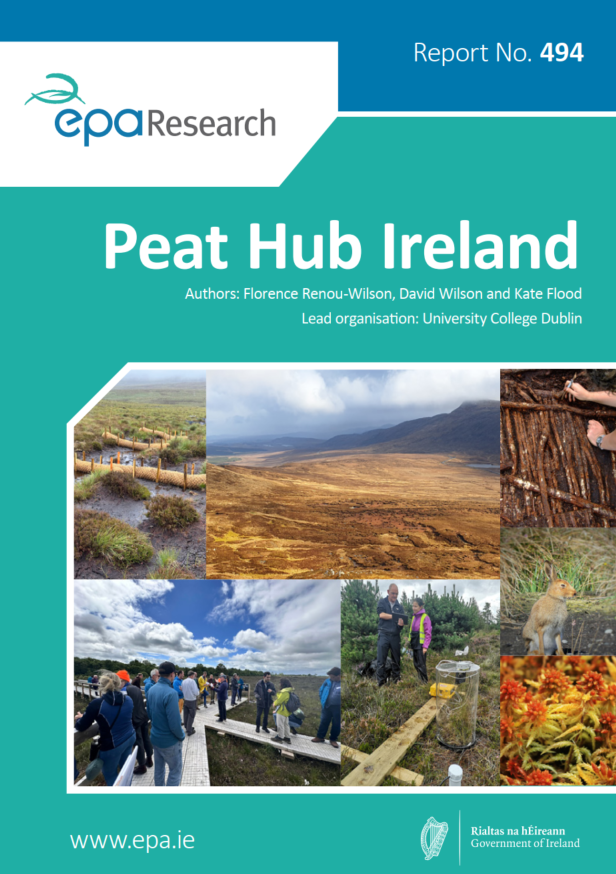
Research 494: Peat Hub Ireland
Authors: Florence Renou-Wilson, David Wilson and Kate Flood
Summary: Healthy peatlands offer vital benefits for human well-being, including cleaner air and water, carbon storage, and cultural value. Across Europe, there is growing recognition of the need to protect undrained peatlands, rewet drained ones, and restore degraded areas. The Peat Hub Ireland project led by a team from University College Dublin reviewed Irish peatland research from 2000–2023 to identify trends, risks, and knowledge gaps. It highlighted 71 research gaps and 96 priority actions across biodiversity, climate, policy, and more. Peat Hub Ireland also produced a glossary, open-source database, and 10 thematic factsheets to support accessible knowledge sharing. The research findings provide policymakers, researchers, and civil society with evidence-based information. It also provides tools to support decision-making around sustainable management and governance of peatlands in Ireland as a critical national resource.
Project highlights video
What did this research aim to address?
Healthy peatlands provide a range of benefits for human health and well-being, including improved air and water quality, water regulation, lower carbon emissions and access to natural and cultural heritage. Research and policy across Europe highlight the need for protection of undrained peatlands, rewetting of drained peatlands and restoration of degraded peatlands. This is essential to achieve global and EU goals on climate, soil, water and biodiversity. In Ireland and in other regions, peatland research has expanded rapidly in the last two decades, encompassing a diverse, multidisciplinary evidence base. In this context, it is important to synthesise existing knowledge, understand knowledge gaps and uncertainties, and provide a roadmap for the future sustainable management of Irish peatlands. The Peat Hub Ireland (PHI) project synthesised Irish peatland research from 2000 to 2023 to identify key trends, risks and knowledge gaps, providing researchers, policymakers and civil society with reliable evidence to guide future peatlands research, sustainable peatland management and informed decision-making for Irish peatlands, a critical national resource.
What did this research find?
The PHI project synthesised over two decades of peatland research to provide actionable insights for sustainable peatland management, identifying 71 research gaps and 96 priority actions across biodiversity, climate, policy and other key themes. The project incorporated expert and stakeholder knowledge with peer-reviewed and grey literature to represent the wide knowledge base needed for sustainable peatland management. The project’s findings support evidence-based decision-making through four strategic recommendations, each serving as a foundational pillar to achieve sustainable peatland management: (1) accountability in the area of policy, regulations and governance; (2) long-term funding mechanisms for monitoring and financial schemes; (3) equity, especially in training and supporting community-led peatland management; and (4) holistic knowledge: a new paradigm for participatory and open research on peatlands. The project developed a peatland glossary, an open-source database and 10 factsheets that provide accessible summaries of each thematic area. A policy brief was also produced with a suite of recommendations to support policymakers in implementing the global and national policies required to drive sustainable peatland management.
How can the research findings be used?
The findings provide researchers, policymakers and civil society with accessible, reliable and up-to-date evidence for sustainable peatland management in Ireland. The evidence synthesis process, incorporating expert and stakeholder knowledge and evidence from multiple resources, produced several outputs for all stakeholders.
For policymakers, the 96 actions identified, along with the recommendations, offer a policy roadmap – including enforcing regulations, securing long-term funding and fostering cross-sectoral collaboration – for meeting Ireland’s climate and biodiversity targets through sustainable peatland management.
For researchers, the study identifies 71 critical research gaps (of which 50% are high priority) and advocates for open science, interdisciplinary collaboration, participatory methodologies and the use of emerging technologies to advance peatland science.
For communities/non-governmental organisations, the report provides an accessible and reliable knowledge base for those seeking to protect, manage or restore local peatlands, and tools for engagement and advocacy, ensuring that local voices shape peatland management.
https://www.epa.ie/media/epa-2020/research/research-publications/Cover-494.png