Latest Research reports
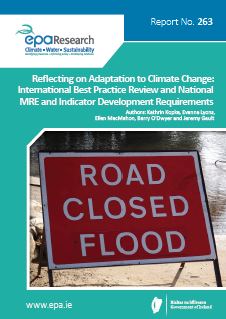
Research 263: Reflecting on Adaptation to Climate Change: International Best Practice Review and National MRE and Indicator Development Requirements.
Authors: Kathrin Kopke, Evanna Lyons, Ellen MacMahon, Barry O’Dwyer and Jeremy Gault., November 2018
Year: 2018
Adaptation Preparedness Indicators for Ireland aims to identify draft adaptation indicator sets. The project carried out a review of international best practice to ascertain criteria and constraints relevant to adaptation indicator development in Ireland.
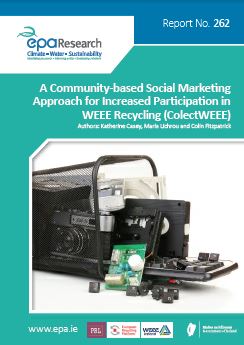
Research 262: A Community Based Social Marketing Approach for Increased Participation in WEEE Recycling (ColectWEEE)
Authors: Katherine Casey, Maria Lichrou and Colin Fitzpatrick, November 2018
Year: 2018
This study explored human behaviour in relation to small WEEE recycling through 26 in-depth interviews with 30 participants; observations and casual conversations at a civic amenity site and waste collection event; and participant observation at 25 retailers. The study proposes a multi-pronged approach to social marketing campaigns with the aim of increasing participation in small WEEE recycling.
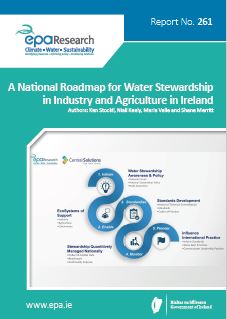
Research 261: A National Roadmap for Water Stewardship in Industry and Agriculture in Ireland
Authors: Ken Stockil, Niall Keely, Maria Valle and Shane Merritt, October 2018
Year: 2018
Following extensive desk research and a process of national and international consultation, this report captures key lessons for Ireland in relation to water stewardship and outlines an integrated roadmap towards establishing the country as a leader in the adoption of water stewardship best practice at both national and local levels in the years ahead.
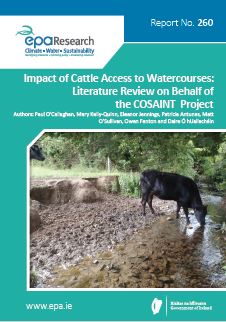
Research 260: Impact of Cattle Access to Watercourses: Literature Review on Behalf of the COSAINT Project
Authors: Paul O’Callaghan, Mary Kelly-Quinn, Eleanor Jennings, Patricia Antunes, Matt O’Sullivan, Owen Fenton and Daire Ó hUallacháin., October 2018
Year: 2018
The primary objective of this literature review was to collate and assess the available literature on the environmental impact of cattle access to watercourses, with an emphasis on empirical research that is directly relevant to the environmental effects.
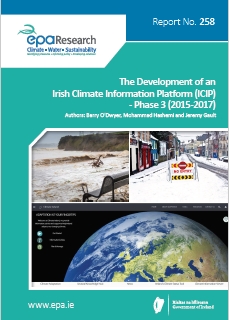
Research 258: The Development of an Irish Climate Information Platform (ICIP) - Phase 3 (2015-2017)
Authors: Barry O’Dwyer, Mohammad Hashemi and Jeremy Gault, September 2018
Year: 2018
The global climate is changing as a result of human influences; the impacts of these changes are already being felt across all continents and oceans and are expected to continue and intensify for many decades to come.
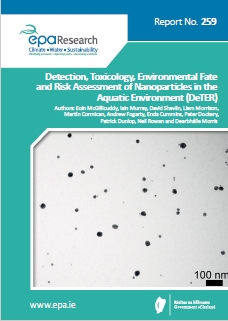
Research 259: Detection, Toxicology, Environmental Fate and Risk Assessment of Nanoparticles in the Aquatic Environment (DeTER)
Authors: Eoin McGillicuddy, Iain Murray, David Shevlin, Liam Morrison, Martin Cormican, Andrew Fogarty, Enda Cummins, Peter Dockery, Patrick Dunlop, Neil Rowan and Dearbháile Morris, September 2018
Year: 2018
Nanotechnology is an emerging technology that has the potential to impact on all aspects of life and the economy and is expected to form the basis of several technological innovations and advances in the 21st century.
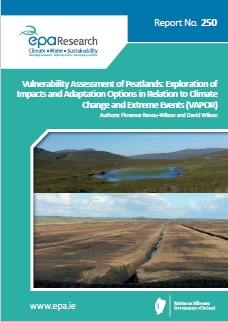
Research 250: Vulnerability Assessment of Peatlands: Exploration of Impacts and Adaptation Options in Relation to Climate Change and Extreme Events (VAPOR)
Authors: Florence Renou-Wilson and David Wilson, September 2018
Year: 2018
The climate changes predicted for Ireland by the end of the 21st century will have significant impacts on drained, rewetted and natural peatland systems. The VAPOR project was established to inform a transition to a climate-resilient Ireland by providing science-based information on the vulnerability of peatlands to climate change, including extreme weather events.
Research 257: An Operational Climate Information Platform for Ireland: Summary Report
Authors: Alastair McKinstry and Eoin McHugh, August 2018
Year: 2018
Information on climate change and options for adaptation can be complex and inaccessible to key stakeholders and decision makers. This project has developed an Operational Climate Information Platform (OCIP) to disseminate the current data and guidance on climate change for Ireland. The OCIP is scalable, maintainable and can be continuously updated with new data that are generated from operational observation systems and research.
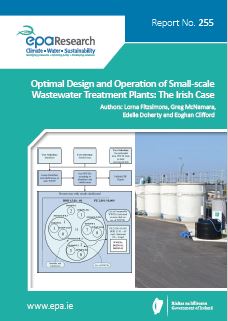
Research 255: Optimal design and operation of small-scale wastewater treatment plants: the Irish case
Authors: Lorna Fitzsimons, Greg McNamara, Edelle Doherty and Eoghan Clifford, August 2018
Year: 2018
There are many variables which must be considered when designing and operating a wastewater treatment system. The key objectives of this research were to develop software tools to assist in the selection and management of wastewater treatment systems, with a specific focus on small wastewater treatment plants in Ireland.
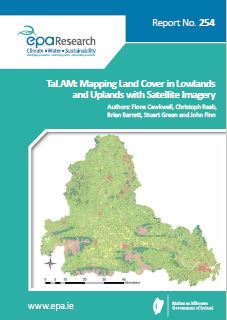
Research 254: TaLAM: Mapping Land Cover in Lowlands and Uplands with Satellite Imagery
Authors: Fiona Cawkwell, Christoph Raab, Brian Barrett, Stuart Green and John Finn, August 2018
Year: 2018
The Towards Land Cover Accounting and Monitoring (TaLAM) project is part of Ireland’s response to creating a national land cover mapping programme. Its aims are to demonstrate how the new digital map of Ireland, Prime2, from Ordnance Survey Ireland (OSI), can be combined with satellite imagery to produce land cover maps.
Research 256: National Preparedness to Adapt to Climate Change: Analysis of State of Play
Author: Margaret Desmond, June 2018
Year: 2018
The goal of international and national climate adaptation policy is the transition to a low-carbon, climate-resilient society and economy. This new assessment interrogates in detail Ireland’s preparedness for adaptation action, with a focus on seven key areas related to the adaptation plan-making process.
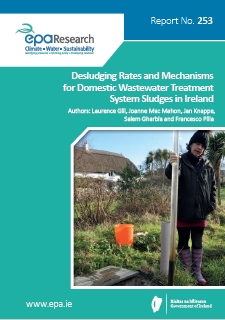
Research 253: Desludging Rates and Mechanisms for Domestic Wastewater Treatment System Sludges in Ireland
Authors: Laurence Gill, Joanne Mac Mahon, Jan Knappe, Salem Gharbia and Francesco Pilla, May 2018
Year: 2018
This study has produced a set of guidelines for owners of septic tanks and packaged treatment systems to help to address the lack of understanding among homeowners of how their domestic wastewater treatment systems operate and to encourage responsible operation and maintenance.
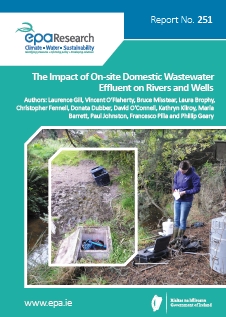
Research 251: The Impact of On-site Domestic Wastewater Effluent on Rivers and Wells
Authors: Laurence Gill, Vincent O’Flaherty, Bruce Misstear, Laura Brophy, Christopher Fennell, Donata Dubber, David O’Connell, Kathryn Kilroy, Maria Barrett, Paul Johnston, Francesco Pilla and Phillip Geary, May 2018
Year: 2018
This research project evaluated the impact of domestic wastewater treatment system (DWWTS) effluent as a health hazard to consumers of groundwater from private wells and also a source of nutrient water pollution to surface water in small catchments.
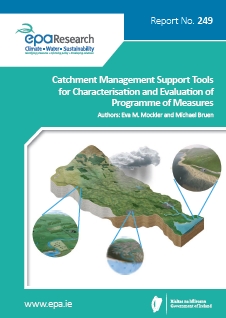
Research 249: Catchment Management Support Tools for Characterisation and Evaluation of Programme of Measures
Authors: Eva M. Mockler and Michael Bruen, May 2018
Year: 2018
Nutrient enrichment and eutrophication can negatively impact on freshwater ecosystems, estuarine and coastal waters. As a result of improvements in nutrient management and regulation, there has been a large reduction in total phosphorus, total ammonia and total nitrogen emissions from Irish catchments in recent decades.
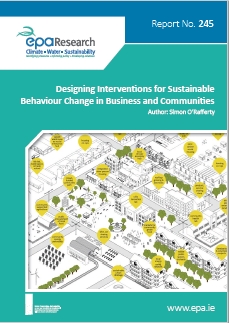
Research 245: Designing Interventions for Sustainable Behaviour Change in Business and Communities
Author: Simon O’Rafferty, May 2018
Year: 2018
Sustainable consumption and production demands behaviour changes. Policymakers and regulators already apply a range of interventions and incentives with a view to changing individual and organisational behaviour. This includes fiscal incentives, subsidies, pricing mechanisms and market-based instruments, standards, eco-labels and communication, business support programmes and curriculum development.
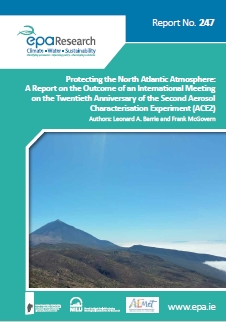
Research 247: Protecting the North Atlantic Atmosphere: A Report on the Outcome of an International Meeting on the Twentieth Anniversary of the Second Aerosol
Authors: Leonard A. Barrie and Frank McGovern, May 2018
Year: 2018
The North Atlantic Ocean is flanked by four major continental regions, and is impacted by emissions from these regions, including those from the major conurbations and industrial regions, as well as by emissions from intercontinental and regional transport systems.
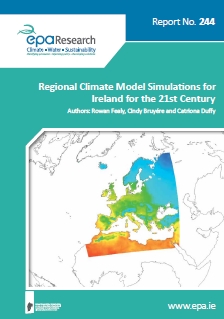
Research 244: Regional Climate Model Simulations for Ireland for the 21st Century
Authors: Rowan Fealy, Cindy Bruyére and Catriona Duffy, May 2018
Year: 2018
The model simulations represent Ireland’s contribution to the European component of the Coordinated Regional Downscaling Experiment (EURO-CORDEX), a World Climate Research Programme (WCRP) initiative to address climate information needs at the regional level.
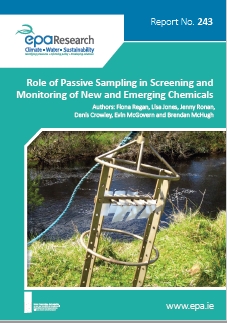
Research 243: Role of Passive Sampling in Screening and Monitoring of New and Emerging Chemicals
Authors: Fiona Regan, Lisa Jones, Jenny Ronan, Denis Crowley, Evin McGovern and Brendan McHugh, April 2018
Year: 2018
Passive sampling (PS) techniques are rapidly developing as very cost-effective state-of-the-art tools for identifying and measuring ultra-trace micropollutants in water.
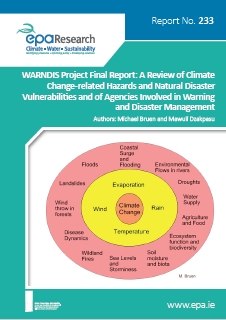
Research 233: WARNDIS Project Final Report: A Review of Climate Change-related Hazards and Natural Disaster Vulnerabilities and of Agencies Involved in Warning
Authors: Michael Bruen and Mawuli Dzakpasu, March 2018
Year: 2018
The purpose of this study was to identify and review the main types of natural disasters that may be impacted by anticipated climate change; identify the key agencies involved; assess their roles and capabilities; and identify existing and new potential data streams to assist with warning and disaster management.
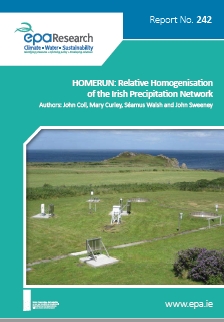
Research 242: HOMERUN: Relative Homogenisation of the Irish Precipitation Network
Authors: John Coll, Mary Curley, Séamus Walsh and John Sweeney, March 2018
Year: 2018
Long instrumental records are rarely, if ever, homogeneous and most decade-to-century-scale time series of atmospheric data have been affected by changes caused by climatic and/or non-climatic factors. Nevertheless, accurate climate data are a prerequisite for basing climate-related decision-making on, and quality-controlled homogenised climate data are becoming integral to efforts across many countries to deliver climate services.