Strategic noise maps
What is a strategic noise map?
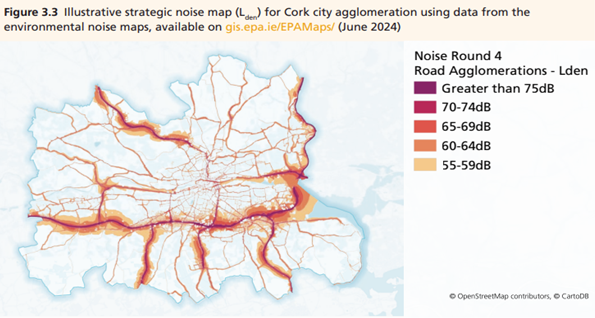
A strategic noise map is designed to assess noise exposure in a given area, resulting from particular noise sources for major roads, major rail, major airports and the cites of Dublin, Cork and Limerick (which each city being referred to as an agglomeration in the regulations)
The strategic noise map is designed to display noise exposure levels in a given area, resulting from particular noise sources for:
- major roads – for more than 3 million vehicle passages per year
- major railways – for more than 30,000 train passages per year
- major airports – for more than 50,000 air movements per year
- major cities – with a population in excess of 100,000 people,
These strategic noise maps are prepared using computer modelling techniques that use various types of source data to estimate noise levels, such as traffic flow, road and rail types, as well as vehicles type and vehicle speed. The strategic noise maps are presented in terms of two noise indicators, Lden and Lnight as outlined below.
A noise map is a graphical representation of the noise in a particular area with different colours representing different noise levels in decibels [dB(A)]. Strategic noise maps have been prepared for Round 4, representing the annual average situation during 2021.
Noise indicators
- Lden refers to the day–evening–night long-term average noise indicator. It is ‘weighted’ to account for extra annoyance in the evening and during night-time periods. The EU’s Environmental Noise Directive (END) mandatory noise level reporting threshold is 55 dB Lden.
- Lnight refers to the night-time long-term average noise indicator and is used in the assessment of sleep disturbance. The EU’s END mandatory noise level reporting threshold is 50 dB Lnight.
Note: Measurements in decibels (dB) correspond to the way our ears interpret sound pressures and are given on a logarithmic scale.
These indicators are based on year-long averages of day-time, evening and night-time periods, which occur within the following time periods:
- Day-time (07:00–19:00)
- Evening (19:00–23:00)
- Night-time (23:00–07:00)
Where can I get the noise mapping data?
The Noise GIS data for Round 4 (2021) is available for viewing on EPA Maps. Navigate to 'Environment and Wellbeing' and in the dropdown menu select 'Noise'.
- Select the required dataset using the slider buttons (e.g. Noise Round 4 Road National - Lnight.)
- Expand the Table of Contents on the left-hand side to view the legend.
- An information section and Full Metadata sets (i) are available on each of the maps.
Note; The main focus of noise maps is for the strategic management of environmental noise, based upon a notional annual average day. The maps can be used to assess noise exposure in a given area.
What is the purpose of strategic noise maps?
The strategic noise maps (SNMs) allow for increased public awareness around noise exposure levels. Data obtained from these Round 4 SNMs has been used to select priority areas for Noise Action Plans. In Ireland, it has been found that road traffic, particularly within urban areas, is the predominant cause of transport noise.
To adequately protect people from the negative health effects that occur as a result of environmental noise, measures such as redesigning roadways, using low noise road surfaces, reducing traffic speed limits, and creating low noise emission zones will be required. Some measures around rail and Dublin airport may also need to be considered.
Who is responsible for strategic noise mapping?
Responsibility for the preparation of the strategic noise maps is delegated to the designated noise mapping bodies:
| Organisation | Responsible for |
|---|---|
| Local Authorities (LA) | Non-national roads |
| Transport Infrastructure Ireland | National roads and the Luas |
| Irish Rail | Heavy rail |
| Dublin Airport Authority (DAA) |
DAA is responsible for the Dublin airport noise map. The airport noise map is then joined to the four LA noise maps for Fingal CC, South Dublin CC, Dublin CC and Dun Laoghaire CC, to produce one overall noise map for the Dublin agglomeration. |
| Agglomeration Cork |
Cork City Council and Cork County Council |
| Agglomeration Dublin |
Dublin City Council, Dun Laoghaire/Rathdown County Council, Fingal County Council and South Dublin County Council |
| Agglomeration Limerick |
Limerick City and County Council and Clare County Council |
Noise maps are prepared every 5 years, with the latest report - Round 4 Strategic Noise Maps available on EPA Maps). The Round 4 Noise action plans (NAPs) should now all be published (see NAP links below).
Data obtained from the mapping is reported to the European Environment Agency (EEA) with information available at Noise (europa.eu). The END defines an Lden threshold of 55 dB and an Lnight threshold of 50 dB for reporting to the EEA on the numbers of people exposed to these minimum day and night-time noise levels.
Overview of data from Round 4 maps for road traffic noise
Results from round 4 noise mapping indicate that approximately 41% of the total population living in the three agglomerations of Dublin, Cork and Limerick were exposed to road traffic noise levels above the END mandatory reporting threshold of ≥ 55 dB Lden. Meanwhile approximately 53% were exposed to road traffic noise above the 53 dB Lden WHO guideline level. Of the population living outside of these urban areas, approximately 22% of the total population living in the mapped areas were exposed to a road transport noise level of ≥ 55 dB Lden (the END reporting threshold) in Table 3.1 below). Please see State of the Environment Report – Chapter 3: Environmental Noise for more information.