Research 504: Sustainable, Biodegradable, Compostable and Recyclable Plastics for Packaging and End-of-life Management
Authors: Ramesh Babu Padamati, Kevin O’Connor, Purabi Bhagabati, Jessica De Micco, Saranya Rameshkumar, Bryan Dalton, Meryem Aqlil, Eoin Bird, Percy Foster and Tony Breton
Summary: In Ireland, plastic waste accounted for nearly 25% of total packaging waste in 2023, with only one-third of this waste recycled. The BioPOST project, led by a team in Trinity College, explored creating biodegradable plastic as sustainable alternatives to support Ireland’s commitment to meet the 55% recycling target by 2030 under the EU Packaging and Packaging Waste Regulation. Testing sorting systems and exploring sustainable recycling options on a pilot scale were also central to the research. Pilot trials achieved 60–90% segregation of biodegradable plastics using optical sorting and demonstrated that most blends were compostable under Irish industrial conditions. Findings show current infrastructural deficits impede effective segregation and recovery and recommend the need for systems for labelling, collection, and recycling to enable bioplastic circularity. Policy actors are provided with feasible options and evidence to produce, sort and recycle biodegradable plastic composites.
Project highlights video
What did this research aim to address?
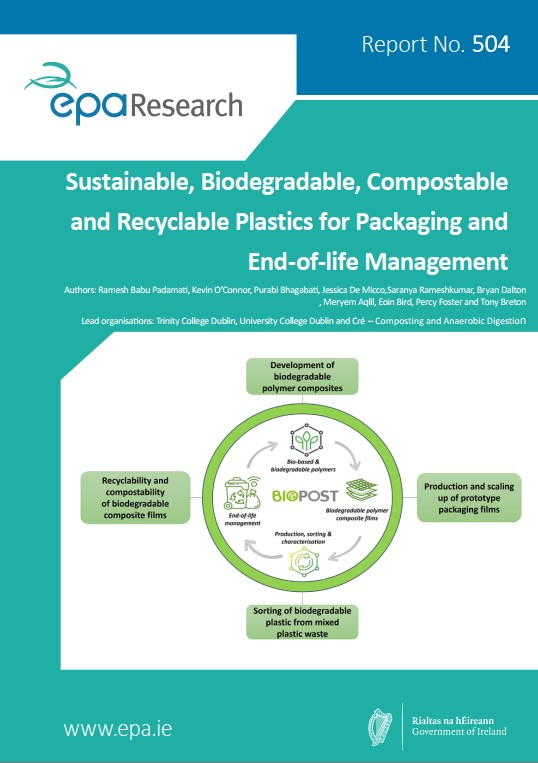
Plastics cause significant pollution and environmental concerns. To meet the 55% recycling target for plastic packaging by 2030, sustainable alternatives like bioplastics and improved recycling systems are essential. In Ireland, plastic waste accounted for nearly 25% of total packaging waste in 2023, yet less than one-third of this waste was recycled. Bioplastics are emerging as promising sustainable alternatives, and the global production is projected to grow from less than 1% to 20% in 5 years. Therefore, developing robust waste management and recycling infrastructure will be essential to comply with the EU’s new packaging and packaging waste regulations. This project focused on creating biodegradable plastic prototypes based on commercial biodegradable polymers, testing sorting systems and exploring sustainable recycling options on a pilot scale. This project aimed to demonstrate a sustainable ecosystem for biodegradable plastic prototypes. Key objectives included producing biodegradable composites and blends using commercial and natural polymers. In addition, the project involved conducting pilot studies to evaluate the feasibility of separating biodegradable plastic waste from mixed plastics using current or enhanced sorting systems, and to explore sustainable recycling options.
What did the research find?
The BioPOST project conducted pilot-scale trials to assess the segregation of biodegradable plastic packaging films from mixed waste using optical sorting technology in Irish recycling plants, achieving a segregation rate of 60–90%. It evaluated 60 blends of biodegradable polymers for biodegradation under Irish industrial composting conditions and selected formulations for mechanical recycling. Key findings include the following:
- Segregated prototype biodegradable plastics were suitable for mechanical recycling.
- Most tested blends, except those containing polybutylene succinate, were fully compostable in Irish industrial composting processes.
- Ireland currently lacks infrastructure for effective segregation and recovery of bioplastics, hindering recycling efforts.
- Establishing systems for labelling, collection, segregation and recycling in line with the EU Packaging and Packaging Waste Regulation is essential for promoting bioplastic circularity and sustainability.
Therefore, it is crucial to establish a system for the labelling, collection, segregation, recycling and disposal of biodegradable plastics in accordance with the new Packaging and Packaging Waste Regulation. The collection and segregation infrastructure is vital for promoting the circularity of bioplastics, especially biodegradable types, to ensure the benefits of compostability and sustainable recycling and recovery options.
How can the research findings be used?
The BioPOST project has demonstrated the feasibility of producing, sorting and recycling biodegradable plastic composites under Irish conditions. To implement these findings, the focus should shift to scaling segregation trials, retrofitting material recovery facilities and improving collection systems to separate biodegradable plastics from conventional plastics. The research supports Ireland's Climate Action Plan and the EU's circular economy goals by promoting closed loop plastic waste management through recycling and composting, reducing environmental impacts.
The findings are relevant to policymakers, waste management authorities and industry stakeholders, offering guidance for developing the Packaging and Packaging Waste Regulation and setting standards for biodegradable plastic products. By 2030, all packaging must be recyclable or designated for composting. Key challenges include scalability, economic viability, and consumer behaviour and waste segregation. Emerging opportunities lie in chemical and enzymatic recycling, and in leveraging compost as a value-added product in the agricultural sector. It is envisaged that continued collaboration across research, industry and policy will be vital to ensure bioplastics contribute effectively to Ireland's transition to a circular economy.
https://www.epa.ie/media/epa-2020/research/research-publications/Cover-504.jpg