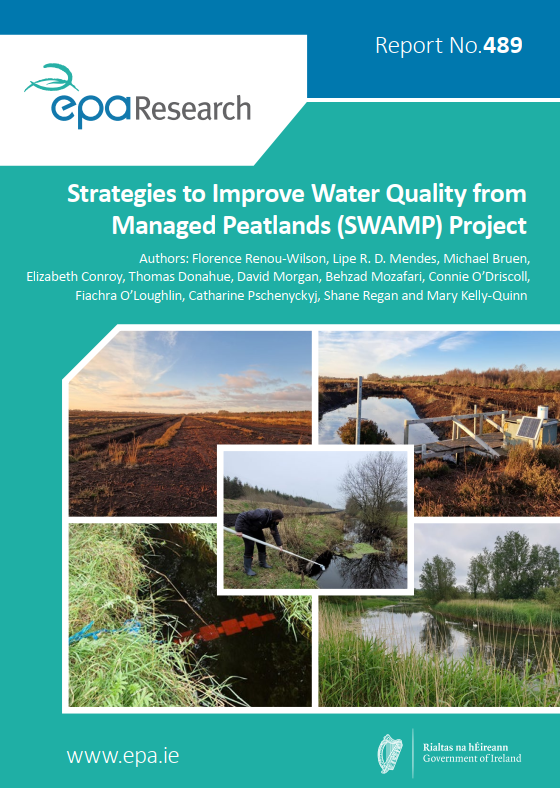
Research 489: Strategies to Improve Water Quality from Managed Peatlands (SWAMP) Project
Authors: Florence Renou-Wilson, Lipe R. D. Mendes, Michael Bruen, Elizabeth Conroy, Thomas Donahue, David Morgan, Behzad Mozafari, Connie O’Driscoll, Fiachra O’Loughlin, Catharine Pschenyckyj, Shane Regan and Mary Kelly-Quinn
Summary: The Strategies to Improve Water Quality from Managed Peatlands (SWAMP) research project aimed to address key knowledge gaps about water quality degradation in Ireland's peatland areas. This degradation is caused by decades of drainage for industrial and domestic peat extraction. The project reveals how long-term drainage for peat extraction and other land uses have negatively impacted Ireland's rivers and streams. Drained peatlands have leached harmful nutrients, acids, and carbon-rich water into these water bodies. The research focuses on identifying pollution hotspots, measuring the effects of peat soil drainage on water chemistry and aquatic biodiversity, assessing pollution prevention measures, and developing better hydrological models to predict the response of peatlands to drainage and restoration. These findings come at a crucial time as Ireland must address the specific challenges of complying with the Water Framework Directive and fulfilling the Nature Restoration Law.
What did this research aim to address?
The Strategies to Improve Water Quality from Managed Peatlands (SWAMP) project sought to tackle critical knowledge gaps about water quality degradation in Ireland’s peatland regions, driven by decades of drainage for industrial and domestic peat extraction. It focused on (i) identifying hotspots of pollution; (ii) quantifying the impacts of drainage of peat soils on stream chemistry and aquatic biodiversity; (iii) assessing current in situ pollution measures as well as innovative methods to treat polluted effluents; and (iv) developing improved hydrological models to predict peatlands’ responses to drainage and restoration. The study focused on the Irish midlands, a hotspot for peatland degradation, to provide actionable science for governmental organisations at the local and national levels as well as for policymakers and restoration practitioners.
What did this research find?
The SWAMP project revealed how decades of peatland drainage for extraction and other land use have harmed Ireland’s rivers and streams. Drained peatlands have leached harmful nutrients, acids and carbon-loaded water into streams. The research identified some protected peatlands that also had poor water chemistry, highlighting the widespread legacy effects of drainage. Aquatic biota in degraded bogs showed reduced biodiversity (e.g. fewer sensitive species and dominance of pollution-tolerant species), although downstream effects were linked to upstream water quality, not bog status alone, underscoring the need for site-specific ecological indices to assess peatland restoration projects.
While sedimentation ponds at the edge of a cutaway bog removed suspended solids, this approach failed to treat dissolved pollutants, with seasonal acidity and nutrient surges further violating ecological standards. Edge-of-field treatments with biochar showed inconclusive results, warranting further study.
Finally, the SWAMP project exposed challenges with hydrological modelling, revealing that no single hydrological model suited all peatland types/catchments due to their heterogeneous responses to peatland management (drainage/rewetting/restoration), demanding site-specific approaches.
How can the research findings be used?
The SWAMP project’s findings arrive at a critical time, as Ireland needs to address the specific challenges of achieving compliance with the EU Water Framework Directive and delivering on the Nature Restoration Law. Reversing centuries of unsustainable peatland management and the declining trend in water quality in streams in the midlands will require considerable effort from all stakeholders. It will require the coordination of multiple agencies to expand the monitoring of peatlands both in space and time and in particular to include water quality indicators at site and regional levels.
Tackling the pollution recorded in bog streams at specific sites will be largely addressed by (i) rewetting and rehabilitation projects within existing drained bogs and (ii) stricter legal requirements for the treatment of effluents associated with peat extraction activities. The SWAMP project’s results provide baseline information for future long-term monitoring and set achievable targets. They also highlight the need for tailored, site-specific approaches rather than one-size-fits-all solutions. Success hinges on interdisciplinary collaboration to address compounding pressures, from legacy drainage impacts to climate change
https://www.epa.ie/media/epa-2020/research/research-publications/Cover-489.png