Freshwater and Marine

The EPA works with others to monitor and assess the health of our rivers, lakes, estuaries and coastal waters under the Water Framework Directive.

What can you do about water quality?

Water quality in Ireland

What do you need to know about water quality?

What's happening with water quality?

Fresh, clean water is vital for all life on earth. Ireland has some of the best water quality and cleanest beaches in Europe. Ireland’s climate means that there is usually enough water to meet the needs of its people and the surrounding environment. 

However, overall our water quality in Ireland is getting worse.

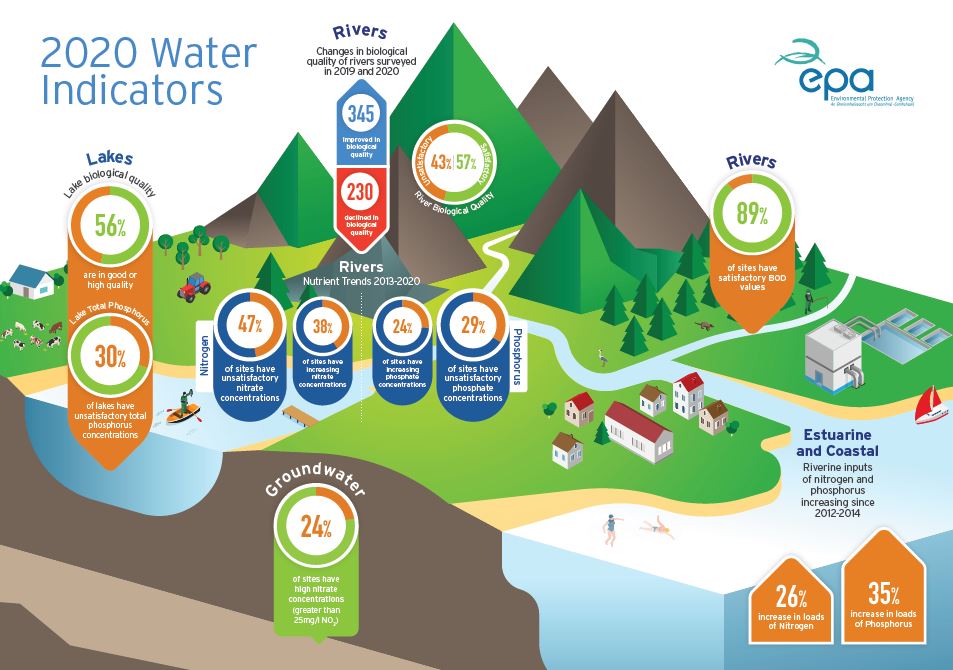
Just over half of Ireland’s surface waters are in good condition. There is a relatively small decline in water quality of our rivers and lakes. The number of estuaries and coastal water bodies in satisfactory condition has also decreased. 

The main threat to water quality is the presence of too much nutrients, such as phosphorus and nitrogen, which come primarily from agriculture and waste water.

Read more about the EPA’s assessments of water quality and agriculture.

When nutrients such as nitrogen and phosphorus enter our waterways they cause an increase in the growth of plants and algae. This in turn clogs up our water courses, uses up oxygen and harms other aquatic life such as insects and fish. 

Nitrates and phosphorous

Nationally, there have been year on year fluctuations, with most recent nutrient concentrations reducing in rivers in most regions. However nitrate concentrations remain too high in rivers, groundwater, and estuaries in the southeastern half of the country. Almost a quarter of all rivers have phosphorus concentrations which are greater than the good water quality standard. 

Nutrient losses from agriculture are one of the significant drivers impacting on our water quality. Read further information on the results of water quality monitoring in 2024, as used to support the assessment of the impact of the nitrate’s derogation on Irish waters.

Find previous water quality assessments of the impact of the nitrate’s derogation on Irish waters for 2023, 2022 and 2021.

Read the most recent Article 10 report on implementation of the Nitrates Directive in Ireland. You can also read historic reports 2016-2019 and 2012-2015.

The evidence shows that the goal of restoring all waters to good status by 2027 will not be achieved. Full implementation of Ireland’s River Basin Management Plan, including targeted action at the local water catchment level, is key to improving water quality. 

What's being done?

The Water Framework Directive

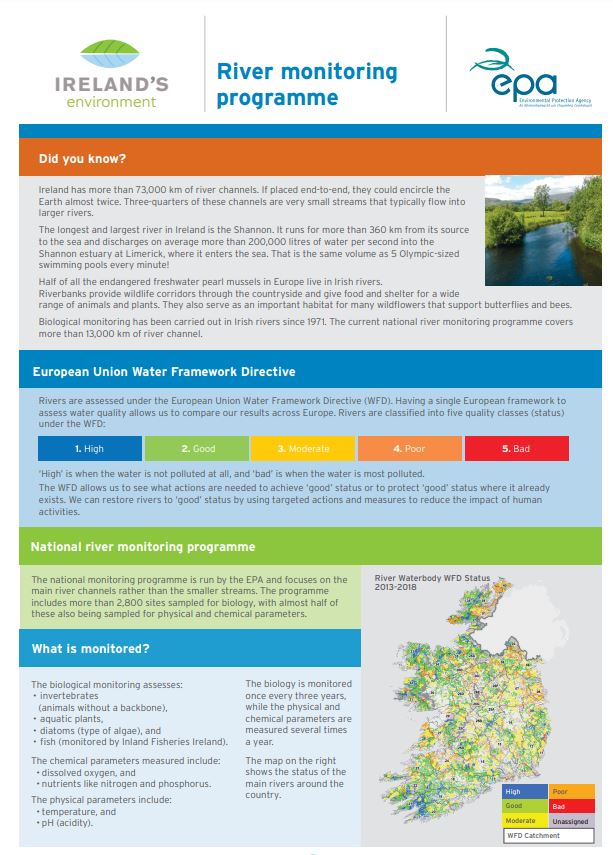
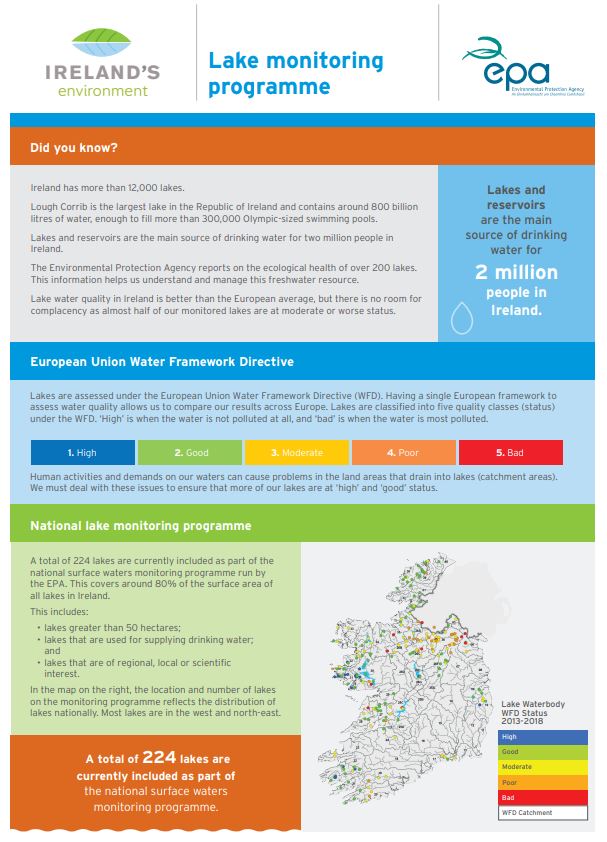
Our rivers, lakes, estuaries, coastal and groundwaters are assessed under the EU Water Framework Directive (WFD). This EU law came into effect in December 2000. Having a single European framework to assess water quality allows us to compare our results across Europe.  

Our surface waters are classified into five quality classes (status) under the WFD: High, Good, Moderate, Poor and Bad.

‘High’ is when the water is unpolluted, and ‘Bad’ is when the water is highly polluted.  Our ground waters fall into two quality classes (status) under the WFD: 'Good and ‘Poor 

The WFD allows us to see where actions are needed to achieve Good status or to protect Good or High status where it already exists. It also helps us identify what actions need to be taken. We can restore rivers to Good and High status by using targeted actions and measures to reduce the impact of human activities.  

The River Basin Management Plan

The River Basin Management Plan outlines Ireland's policy repsonse to the challenge of protecting and restoring water quality. The plan is published on a 6-year cycle by the Department of Housing, Local Government and Heritage. It includes targeted actions and measures to protect and restore water quality.

Learn about the River Basin Management Plan 2018-2021

Featured reports on Freshwater & Marine

in: Freshwater & Marine
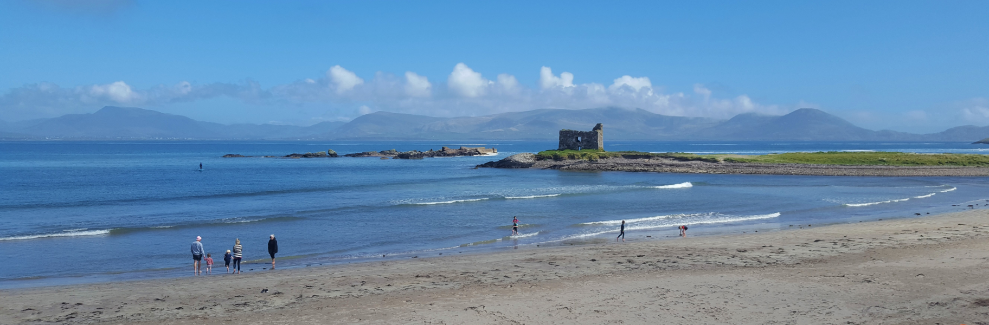
Inch Beach Kerry
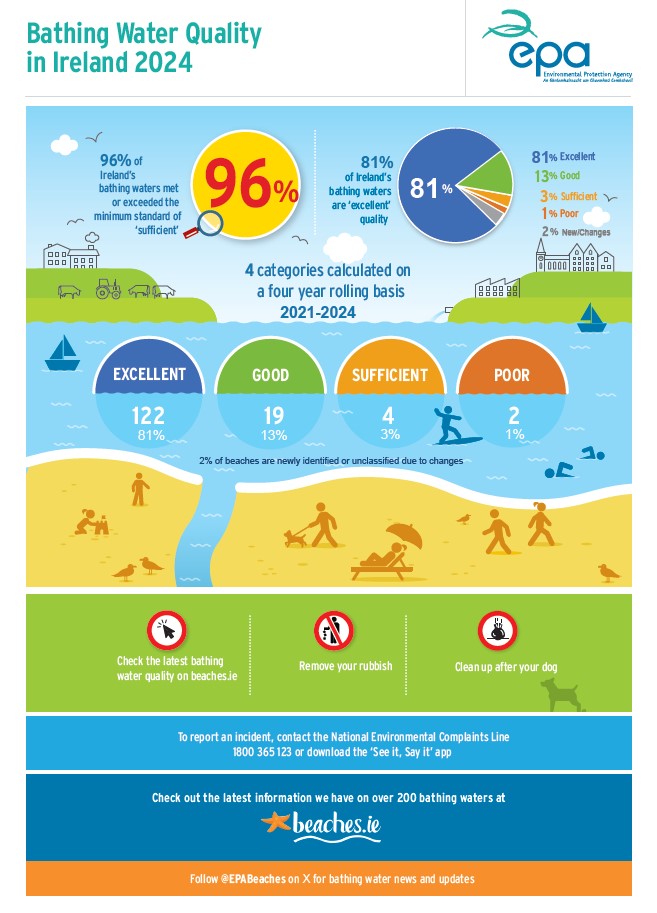
Bathing Water Quality in Ireland 2024

Bathing Water Quality in Ireland 2024

The 2024 EPA Bathing Water report sets out bathing water quality at Ireland's beaches during the summer 2024 bathing water season.

Water Quality in Ireland 2023 Indicators report lrg feature item
Water Quality in 2023

An Indicators Report

This report provides an update on the quality of water in Ireland's rivers, lakes, transitional and coastal waters and groundwater using information collected in 2023.

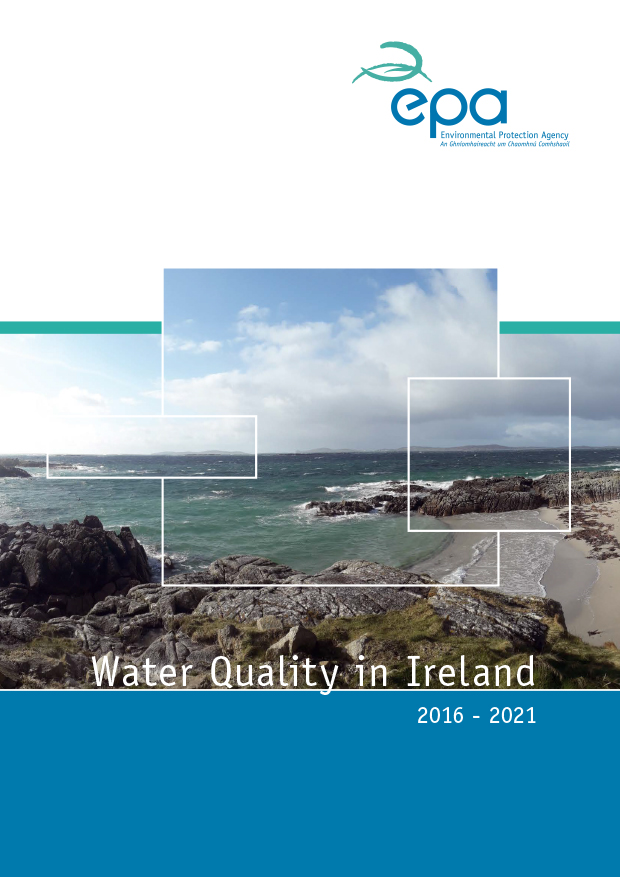
Water Quality Report 2016-2021 Cover
Water Quality in Ireland 2016 – 2021

This report sets out the assessment of the health of Ireland’s rivers, lakes, canals, groundwaters, transitional (estuaries) and coastal waters. The analysis is based on the assessment of over 4,000 surface water bodies and 514 groundwater bodies over the period 2016-2021.

Ireland's National Water Framework Directive Monitoring Programme, 2019-2021 cover
Ireland's National Water Framework Directive Monitoring Programme, 2019-2021

This document presents Ireland’s national WFD monitoring programme for surface and groundwater bodies.

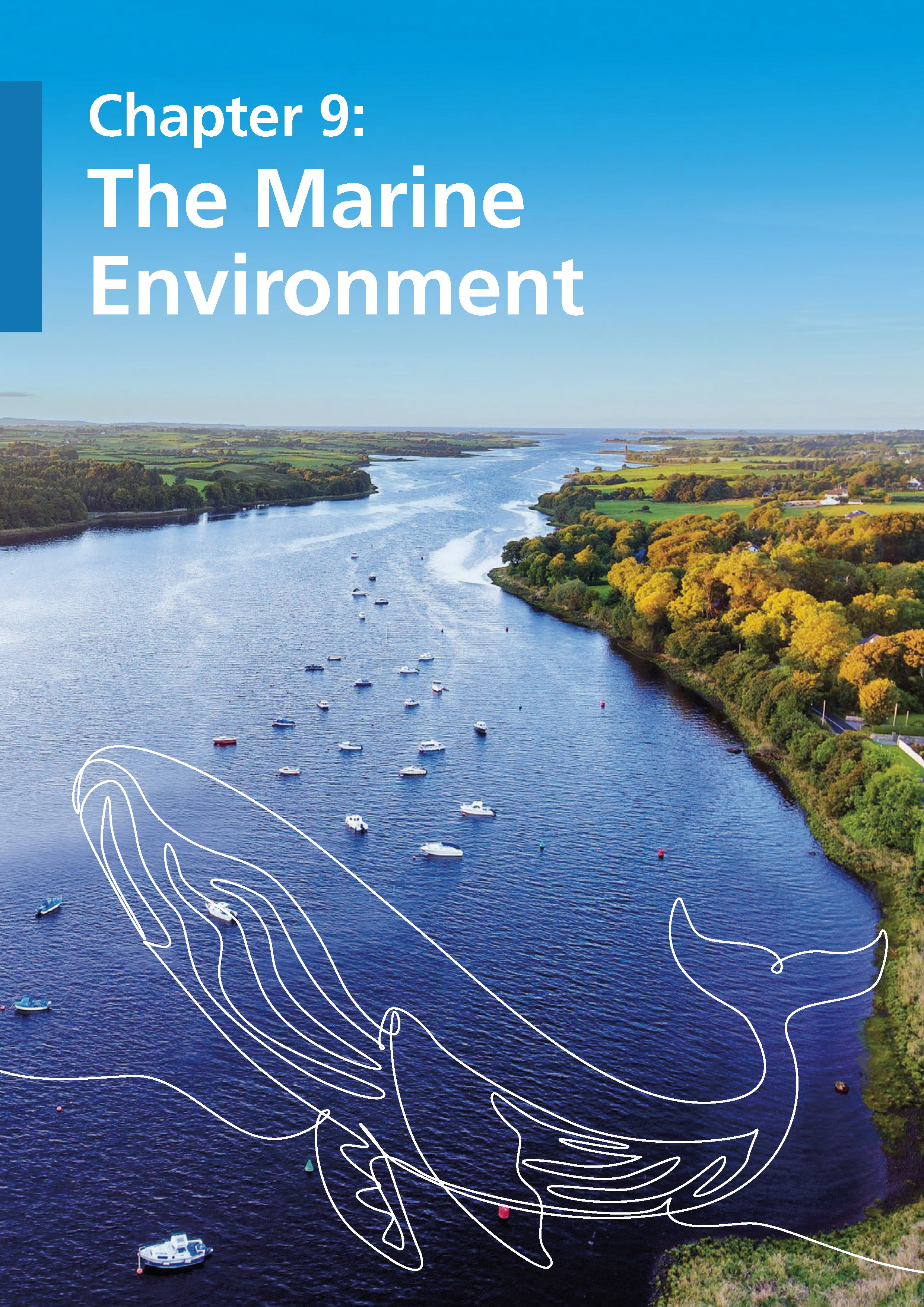
Sketch outline of great blue whale with photo of river with boats on it as background
Ireland's State of the Environment Report 2024 - Chapter 9 The Marine Environment

Ireland’s State of the Environment Report 2024 provides an update on the environmental challenges that we face both nationally and globally. This is chapter 9 from the report which summarizes the key messages and environmental challenges for the Marine Environment in Ireland.

FAQs about freshwater & marine

in: Freshwater and Marine

The EPA works with others to monitor and assess the health of our rivers, lakes, estuaries and coastal waters under the Water Framework Directive.

FAQs on freshwater & marine

Infographics and factsheets on freshwater & marine

Learn more about water quality in Ireland - watch talks from the 2024 EPA Water Conference