View our privacy statement for more information and how to manage them.
Environmental Protection Agency’s RoleWater Services Authority RoleEngage a Competent PersonUnsolicited adviceFinancial Assistance What standard do you have to meet? Do I need planning permission?Buying a NEW systemInstallation of a new systemDe-commissioning Disused TanksGroup Sewage SchemesDischarge LicencesAlternative TechnologiesYour Consumer Rights
The Environmental Protection Agency (EPA) provides advice and guidance relating to wastewater treatment and has contributed to the training of inspectors for the purposes of implementing the requirements of the Water Services (Amendment) Act, 2012 and in particular the EPA National Inspection Plan. The EPA published the National Inspection Plan earlier this year and we now have a supervisory role over the Water Services Authorities (WSAs) in their delivery of the inspection and engagement strategies contained in the Plan. The upgrade or remediation of any domestic waste water treatment system required following an inspection is a matter for the local authority and the homeowner. Where remediation is required it is recommended that the homeowner procure the services of a competent wastewater professional to work with the WSA in agreeing a remediation strategy. The following advice is provided to help the homeowner in procuring such services.
Water Services Authority (WSA) are responsible for ensuring that all DWWTS have been registered. They have established a public register of DWWTSs within their functional areas and arranged for a certificate of registration to be issued to applicants who register their systems by the Local Government Management Agency (LGMA).
WSAs are required to undertake inspections in accordance with the National Inspection Plan issued by the EPA. Inspections are due to commence July 2013. Inspectors have been appropriately trained by the Local Authority National Training Services Group (LANTSG) and have been appointed by the EPA. Inspectors have powers to enter and inspect DWWTS as directed by a WSA; conduct monitoring, sampling, photographs, survey, excavate etc; request information regarding maintenance, and, servicing and operation of DWWTS.
Following an inspection the WSA shall issue an inspection report in all cases and an Advisory Notice where the inspection identifies that the treatment system:
The main provisions of the Advisory Notice will:
Be cautious of any individuals calling to your home posing as inspectors or as service providers. Be careful to check and verify their identification and certificate of appointment (for inspectors). In the case of inspections, you will be notified of any inspection in advance by your WSA.
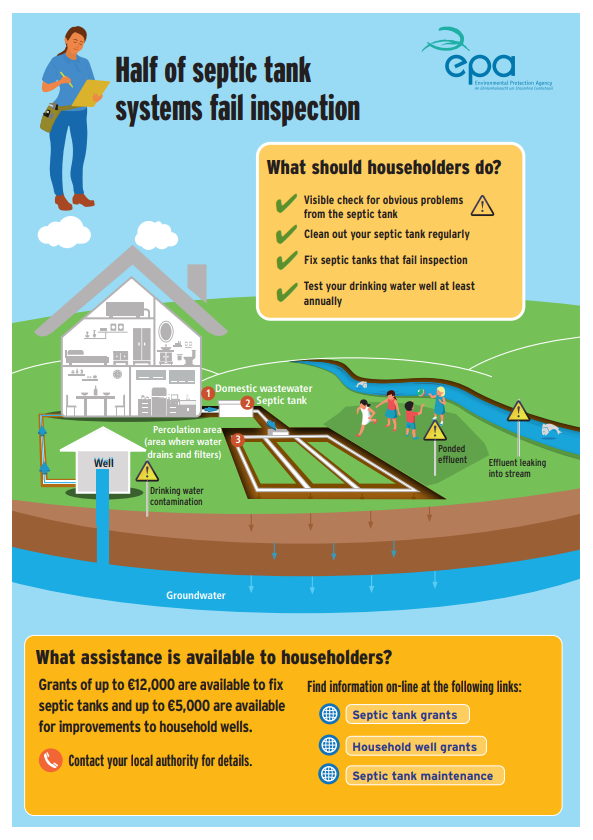
The Minister for the Environment, Community and Local Government (DECLG) announced a grant scheme to provide financial assistance to households whose septic tanks and other domestic waste water treatment systems, require remediation or upgrading following inspection under the Water Services (Amendment) Act 2012. Grants are available for the carrying out of remediation, repair or upgrading works to, or replacement of, a domestic waste water treatment system, where such remediation, repair, upgrading or replacement arises directly from an inspection and subsequent issue of an advisory notice under the Water Services (Amendment) Act 2012. One of a number of strict conditions of eligibility for grant aid will be that the householder has registered their system by the prescribed date of 1 February 2013 and the grant amount is dependent on household income level. More details are available from the DECLG - DECLG Grant information and Grant legislation.
Contact your local authority for further information.
The standards were set in the legislation Water Services Act 2007 and 2012 (Domestic Waste Water Treatment Systems) Regulations, S.I. 223 of 2012. The remediation solution should be such that it embraces best practice. Remediation of existing DWWTS may have regard to the techniques, technologies and solutions set out in the EPA Code of Practice: Wastewater Treatment Systems serving Single Houses (p.e. <10) (EPA, 2009) but it is not bound by the full requirements of the code. The wastewater professional should demonstrate that the proposed solution will result in improved treatment and reduced risk to human health and the environment. The professional should work with the WSA and the homeowner to come up with the cost effective solution for the site having regard to the requirements to protect human health and the environment.
NOTE: Check with your WSA and local planning authority before carrying out any works.
A specific exemption under the planning regulations has been provided by the Minister for remedial works on foot of an Advisory Notice issued under the Water Service (Amendment) Act, 2012. The WSA will carry out a certain number of inspections annually in line with the requirements of the National Inspections Plan and where they find a failure to meet the regulations then an Advisory Notice will be issued by the WSA.
Where someone in any event or prior to an inspection wants to upgrade a DWWTS voluntarily they need to be aware of:
The requirements of the legislation (S.I. No. 223 of 2012) and in particular the obligations placed on owners of DWWTS. The shall ensure that the DWWTS is not leaking or has an unauthorised discharge to surface waters, that there is no ponding of effluent on the ground surface and that they ensure that greywater enters the system and rainwater and clean surface water is excluded. Owners are obliged to maintain their system such that it does not pose a risk to human health or the environment and in particular that the tank is de-sludged/emptied as appropriate.
If you are planning to upgrade your system in any event and prior to any inspection then please note the following:
Always contact your local authority planning section to discuss what works are proposed in advance of carrying out any works.
Note: Screening for certain works may be required to comply with our obligations under the Habitats Directive with respect to sites within or impacting on certain designated areas etc. such as Natura 2000 sites and the requirement for screening should be discussed in advance with the planning authority .
Once your wastewater professional has completed an assessment and has given you a written report including his/her recommendation of the range of wastewater treatment systems available, you should then consider the following having regard to any planning requirements/Advisory Notice conditions:
The homeowner is legally responsible for the operation of their wastewater treatment system in accordance with Section 70 of the Water Services (Amendment) Act, 2012 (S.I. No. 2 of 2012). Correct installation and maintenance are critical in ensuring correct operation of all wastewater treatment systems and protection of public health and the environment. Homeowners are advised to obtain relevant documentation from the installer/manufacturer in relation to installation and maintenance including costs. It is also important that maintenance contracts be renewed periodically. Certification by a competent person of installation may be required in planning conditions and should be checked with the local authority. All documentation should be retained for future reference.
Abandoned/disused septic tanks pose a risk to human health and the environment and they should be properly de-commissioned. General guidelines are as follows:
In certain situations where the ground conditions are unsuitable for conventional systems, the most cost effective solution for a group of houses may be a group sewage scheme. These are similar to the group water schemes whereby a group of individuals come together to treat their wastewater or lay a private sewer to connect to the public sewer. A grant may be available under the Rural Water Programme, which is administrated by the local authorities on behalf of the Department of Environment, Community and Local Government. A grant of up to 6,500 euro per house or 75% of the cost of a scheme whichever is the lesser may be available for Group Sewerage Schemes where a number of households provide a shared sewage collection/disposal system.
Contact the Department of Housing, Planning, Community, and Local Government for more information.
Any discharge from a wastewater treatment system including the percolation area/polishing filter directly to surface water requires a Water Pollution Act discharge licence issued from the WSA.
Contact your local authority environment section for further information.
The EPA Code of Practice: Waste Water Treatment and Disposal Systems serving Single Houses (p.e.<10) allows for the use of innovative products and technologies, not specifically covered by the CoP so long as they are certified, are fit for the purpose for which they are intended and meet the performance requirements of the CoP. While upgrades do not have to meet the full requirements of the code it would be prudent to have regard to the provision for alternative technologies.
A number of alternative technologies are under review as part of an EPA STRIVE funded research project: Assessment of disposal options for treated wastewater from single houses in low permeability subsoil. Willow systems (zero discharge), low pressure and drip feed systems are some of the technologies being investigated. A final report is due to be published in early 2014.
In addition, to these systems there are others on the market such as cesspools and composting toilets, which have been used in other counties.
With an estimated water consumption of 150 Lcd (litre per capita per day), which is high compared to other western European countries (e.g. UK, Germany, Denmark), there is a high potential to reduce the water consumption in Irish households. Reduced water consumption means reduced wastewater production which is particularly attractive for domestic waste water treatment systems in low permeability subsoils where reductions in effluent load should improve the functioning of the soil attenuation system. For further information on water saving devices can be found on the EPA website.
Consumers have legal rights when employing a person acting in the course of a business or profession to carry out a service. In employing a wastewater professional, you are availing of a service and have consumer rights. You therefore have a right to expect that the wastewater professional has the necessary skill to carry out the work and that he/she will carry out the work with due care and diligence. If the service is not carried out properly you have a right under law to redress from the service provider.
The forms of redress are also covered under the Sale of Goods and Supply of Services Act, 1980.
If the consumer can reasonably outline why the service was not carried out with due care and diligence and has lost confidence in the wastewater professional’s skill, the consumer may be due a full refund without a further assessment and be able to employ a different wastewater professional to carry out the service properly.
If the wastewater treatment system you purchased does not work properly or you find that it is not what you ordered or what was described to you verbally or in a brochure (e.g. smaller or bigger size/capacity than you were led to believe) or does not last a reasonable lifetime, you have a right to seek redress from the seller/supplier as outlined above.
You may also download these Remediation and Replacement of Domestic Waste Water Systems (DWWTS) .