The EPA's Role in addressing climate change
The EPA’s role in addressing climate change challenges includes collating national greenhouse gas emissions and projections; regulating emissions from industrial sectors; supporting climate science research; supporting behavioural change and facilitating the National Dialogue on Climate Action. Note: These pages present provisional 1990-2025 Inventory data (updated July 2026) and the EPA's latest 2025-2030 projections estimates (updated May 2026).


Reduce your transport carbon footprint, improve the energy efficiency of your home and avoid food waste - a climate action you can do every day.
Remember:
“EVERY BIT OF WARMING MATTERS. EVERY YEAR MATTERS.
EVERY CHOICE MATTERS”
Intergovernmental Panel on Climate Change
Greenhouse gas emissions Ireland

Key messages
Greenhouse gas (GHG) emissions in Ireland decreased in 2025
Annual change in Ireland's total GHG emissions
-2.3%Emissions decreases were driven by the reductions in the Energy Industries, Residential, Transport and Manufacturing Combustion sectors. The overall emissions reduction, while welcome, falls short of reductions required to achieve National and new EU targets.

Latest emissions estimates
Ireland’s latest greenhouse gas (GHG) emissions 1990-2025 are figures based on the latest available data from all sectors.
Latest emissions data
52.65 Mt CO₂eqIreland’s GHG emissions are estimated to be 52.65 million tonnes carbon dioxide equivalent (Mt CO₂eq) without LULUCF in 2025

Energy industries
The Energy Industries sector was responsible for 12.5% of Ireland's GHG emissions in 2025. Greenhouse gas emissions decreased for the fourth consecutive year in 2025 due to the reduction in coal use and an increase in renewable energy for electricity generation and imported electricity through interconnectors.
Annual change in Energy Industries emissions
-7.1%There were decreases in coal (-63.1%), oil (-24.7%) and natural gas (-1.6%) used in electricity generation in 2025. Natural gas, renewables and imported electricity contributed 40.2%, 40.6% and 16.4%, respectively.

Residential
The Residential sector was responsible for 9.9% of Ireland's GHG emissions in 2025, after an increase of 4.9% in 2024, with 2025 being the lowest point in emissions since 1990.
Annual change in Residential emissions
-5.0%Compared to 2024, the decrease was driven by 4.1% less heating degree days. There were decreases in Residential usage of coal (-13.5%), oil (-4.8%), and natural gas (-5.2%).

Transport
The Transport sector was responsible for 22.0% of Ireland's GHG emissions in 2025, driven mainly by a 14.9% increase in biofuel use, following a decreases of 1.2% in 2024.
Annual change in Transport emissions
-1.5%At the end of 2025, there were almost 204,000 electric vehicles in Ireland, exceeding the Climate Action Plan target for 2025 by approximately 5%.

Agriculture
The decrease in emissions in 2025 was primarily driven by a reduction in the total cattle population (-3.3%), including a reduction in dairy cows (-0.9%) for the second time since 2010. An increase in nitrogen fertiliser use (12.7%) partially diminished the reductions achieved in the sector overall.
Annual change in agriculture emissions
-0.2%In the agriculture inventory, the main sources estimated are emissions from enteric fermentation and manure management of livestock and emissions from agricultural soils, including use of nitrogen fertiliser, lime and urea.


Commercial and Public services
The Commercial and Public Services sector includes emissions from fuel combustion for space and hot water heating in commercial and public buildings in Ireland and accounted for 2.6% of Ireland’s GHG emissions in 2025.
Annual change in Commercial and Public Services emissions
-3.5%Emissions from Commercial Services and Public Services decreased by 4.0% and 3.0%, respectively in 2025, driven by 4.1% less heating degree days.

Manufacturing combustion
The Manufacturing Combustion sector was responsible for 7.9% of Ireland’s total GHG emissions in 2025. This sector also includes combustion for combined heat and power for own use in these industries.
Annual change in Manufacturing Combustion emissions
-3.9%In 2025, significant fuel reductions occurred in this sector with coal, oil and natural gas use decreasing by 25.5%, 6.5% and 2.7% respectively.

Industrial processes
In 2025, the Industrial Processes sector was responsible for 3.5% of Ireland's total GHG emissions.
Annual change in Industrial Processes emissions
-1.8%Total process emissions from the mineral products subsector (including cement) decreased by 1.9% in line with a reduction in production.
LULUCF
LULUCF is comprised of six land use categories, Forest land, Cropland, Grassland, Wetlands, Settlements, and Other land, as well as Harvested Wood products. The provisional 2025 LULUCF emissions data are based on the 1990-2024 final inventory data. This sector accounts for 4.6% of national total emissions (including LULUCF).
Annual change in LULUCF emissions between 2023 and 2024
-15.2%This sector is a net source of carbon in all years with 2.5 Mt CO₂ eq emitted in 2024. Forest lands and harvested products are a carbon sink (CO₂ removal) for all years, while drainage of grasslands on organic soils and drainage of wetlands for peat extraction are the main sources of emissions.

Assessment of compliance
The estimates of greenhouse gas emissions indicate that Ireland exceeds its 2025 annual limit, without the use of flexibilities, set under the EU’s Effort Sharing Regulation (ESR) by 4.9 Mt CO₂eq
Compliance with national target requires a reduction of
51%by 2030 compared to 2018. National total emissions (including LULUCF) for 2021 to 2025 have used 99.6% of the 295 Mt CO₂eq Carbon Budget for the five-year period 2021-2025
Key trends in emissions by gas
Emissions by gas type
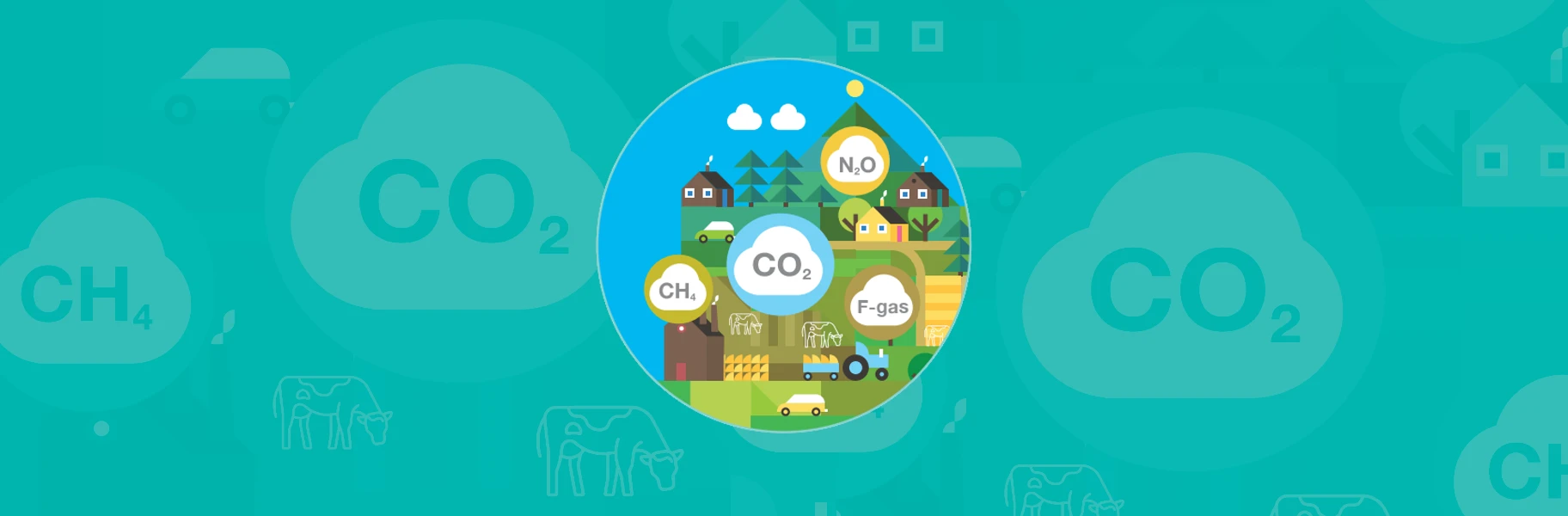
Emissions of carbon dioxide (CO₂) accounted for 59.9% of the national total GHG emissions (excluding LULUCF) of 52,649 kt CO₂ equivalent in 2025, with CH₄ and N₂O contributing 28.8% and 10.1%, respectively. The combined emissions of HFCs, PFCs, SF₆ and NF₃ accounted for 1.2% of total GHG emissions in 2025
Share by gas
Carbon dioxide (CO₂) is the most significant contributor to the greenhouse gas emissions. Emissions of CO₂ are primarily due to combustion of fossil fuels in all sectors
Methane (CH₄) is the second most significant contributor to greenhouse gas emissions in Ireland and is primarily due to the agriculture sector and the large animal population with a smaller contribution from the waste sector.
The largest contributor to nitrous oxide (N₂O) emissions is the Agriculture sector with 89.3% share of total N₂O emissions in 2025.
The emissions of HFCs, PFCs, SF₆ and NF₃ (F-gases) are mainly attributed to refrigeration and air conditioning emissions.
Quarterly GHG Emissions Indicators Q1 2026

Report notes
This is the latest EPA report on quarterly greenhouse gas emissions for Ireland to support more frequent monitoring of national and sectoral progress on climate action. This series complements the national greenhouse gas inventory and projections prepared annually by the EPA. Greenhouse gas emissions in Quarter 1 2026 decreased by 0.8% compared with the same quarter in 2025. The reduction was driven mainly by lower emissions in the Transport sector, down 2.6%, and the Electricity sector, down 2.2%. These decreases were partially offset by increases in Agriculture, up 0.5%, and Industry, up 0.6%. Buildings emissions decreased by 0.3%, while emissions from the Other sector decreased by 8.1%.
Key findings
In Quarter 1 2026, greenhouse gas emissions decreased by 0.8%, or 105.3 kt CO₂ eq, compared with the same quarter last year. The reduction was driven mainly by lower emissions from Transport and Electricity, partially offset by increases in Agriculture and Industry.
The largest sectoral reduction in Quarter 1 2026 was recorded in the Transport sector, where emissions decreased by 2.6%, or 72.1 kt CO₂ eq, compared with the same quarter last year. This was driven mainly by lower road transport emissions, reflecting decreased diesel sales, partially offset by increased petrol sales.
Emissions from the Electricity sector decreased by 2.2%, or 33.3 kt CO₂ eq, compared with Quarter 1 2025, despite a 4.2% increase in overall electricity demand. The reduction reflected increased renewable electricity generation and electricity imports, alongside lower non-renewable generation.
Compared with Quarter 4 2025, overall emissions in Quarter 1 2026 were broadly unchanged, increasing by less than 0.1%, or 3.4 kt CO₂ eq, on a seasonally adjusted basis. Increases in Agriculture and Industry were largely offset by lower emissions from Transport, Buildings, Electricity and Other.
FAQs on greenhouse gas (GHG)
Ireland's GHG emissions inventory
The United Nations Framework Convention on Climate Change (UNFCCC) and its Kyoto Protocol provide the basis for international action to address climate change. The objective of the UNFCCC is to stabilise greenhouse gas (GHG) concentrations in the atmosphere at a level that would prevent dangerous human-induced interference with the climate system. The ability of the international community to achieve this objective is dependent on an accurate knowledge of emissions trends, and on our collective ability to alter these trends. Reliable GHG inventories are essential, both at national and international level. Parties to the convention and its Kyoto Protocol are committed to developing and publishing the national emission inventories of GHGs which is a key element of assessing progress towards meeting commitments and targets.
The EPA has overall responsibility for the national greenhouse gas inventory in Ireland's national system and compiles Ireland's national greenhouse gas emission inventory on an annual basis.
Emissions data for the following gases is reported on an annual basis: carbon dioxide (CO2), methane (CH4), nitrous oxide (N2O), hydrofluorocarbons (HFCs), perfluorocarbons (PFCs), sulphur hexafluoride (SF6), and nitrogen trifluoride (NF3).
Ireland's GHG emissions projections
The National Climate Change Strategy (2007) designated the EPA with responsibility for developing national emission projections for greenhouse gases for all key sectors of the economy. Emission projections serve to inform national policy initiatives and allow Ireland to comply with EU and UN reporting obligations on emissions projections. The EPA produces national greenhouse gas emission projections on an annual basis.
Popular FAQs
-
What are greenhouse gas (GHG) inventories and projections?
A greenhouse gas emission inventory is a compilation of historical greenhouse gas emissions from sources, such as transport, power generation, industry and agriculture, from 1990 to the most recent year for which data is available.
A greenhouse gas emission projection is an estimate of what emission levels are likely to be in the future. They are based on key assumptions such as economic growth, fuel prices and Government policy.
Essentially the inventory data provides a summary of past emissions whereas the projections attempt to estimate the emissions in the future.
National Emission Inventories; The United Nations Framework Convention on Climate Change (UNFCCC) and its Kyoto Protocol provide the basis for international action to address climate change. Parties to the convention and its Kyoto Protocol are committed to developing and publishing the national emission inventories of greenhouse gases (GHGs) which is a key element of assessing progress towards meeting commitments and targets.
The EPA compiles Ireland's national greenhouse gas emission inventory on an annual basis. This inventory is submitted to the European Commission and UNFCCC each year by 15 January and 15 April respectively.
Emissions data for the following gases is reported on an annual basis: carbon dioxide (CO2), methane (CH4), nitrous oxide (N2O), hydrofluorocarbons (HFCs), perfluorocarbons (PFCs), sulphur hexafluoride (SF6), and nitrogen trifluoride (NF3).
Emissions are classified into the ten following sectors; agriculture, transport, energy industries, residential, manufacturing combustion, industrial processes, F-gases, waste, commercial services and public services.
-
How up-to-date is Irish national inventory data?
The data submitted in the current year is the inventory for x-2 years so for example in 2022 the EPA submitted to the EU and UNFCCC, the 1990-2020 time series. All reports and infographics are based on the 1990-x-2 timeseries and the most recent year of data. A provisional estimate of emissions is produced in quarter four of the year before submission and the website will be updated with this provisional data as soon as it is available.
-
What do WEM and WAM scenarios in emissions projections mean?
The EPA greenhouse gas projections are not a forecast but are an estimate of what emissions are likely to be if a specific set of policies and measures are implemented over a defined period of time (e.g. from 2025 to 2030). Two scenarios are considered by the EPA in line with reporting guidelines, the With Existing Measures (WEM) scenario and the With Additional Measures (WAM) scenario.
The WEM scenario is a projection of future emissions based on the measures currently implemented and actions committed to by Government. To become part of the WEM scenario a policy or measure must be in place by the end ofthe latest inventory year and, in parallel, the resources and/or legislation must be in place or committed to by Government Departments or Agencies. The WAM scenario is a projection of future emissions based on implemented measures included in the WEM scenario plus additional planned measures that are under discussion (as per plans, programmes or other policy documents) and have a realistic chance of implementation in the future.
Further information on the policies and measures for the individual sectors that are included in both With Existing Measures and With Additional Measures scenarios in the emissions projections is available in the latest Ireland’s Greenhouse Gas Emissions Projections Report.
-
What are ETS and ESR emissions?
EU greenhouse gas emission targets and reduction obligations for Ireland are split into two broad categories.
The first category covers the large energy and power (i.e. energy intensive) industry which are controlled under the EU Emissions Trading System. Emissions from this category are referred to as “ETS emissions”.
The second category deals with the non- EU Emissions Trading System sectors such as agriculture, transport, residential, commercial, waste and non-energy intensive industry. Emissions from this category are under the scope of the EU’s Effort Sharing Regulation (ESR) and are referred to as “Non-ETS emissions”.
-
What is the Effort Sharing Regulation (ESR) & ESR Annual Limits?
On 14th May 2018, the European Council adopted a regulation (EU 2018/842 – the Effort Sharing Regulation) on greenhouse gas emission reductions. The regulation sets out binding emission reduction targets for member states in sectors falling outside the scope of the EU emissions trading system for the period 2021-2030. In April 2023 the Effort Sharing Regulation was amended (EU 2023/857) and Ireland’s new 2030 target under the Effort Sharing Regulation is to limit its greenhouse gas emissions by at least 42% by 2030.
Annual emission limits out to 2025 for the 42% reduction were set by the EU in 2023, with set limits out to 2030 published in Commission Implementing Decision (EU) 2026/895 of 24 April 2026 amending Implementing Decision (EU) 2020/2126.