Reuse statistics for Ireland
EPA Circular Economy and Waste Statistics data release July 2023. Data reference year 2021.
The EPA Circular Economy and Waste Statistics (CEWS) team have produced the first official statistics for Reuse in Ireland for the reference year 2021, in line with the mandatory reporting required under the revised Waste Framework Directive and Commission Implementing Decision (EU) 2021/19.
What is Reuse?
Reuse is defined as any operation by which products or components that are not waste are used again for the same purpose for which they were conceived. It does not include items which are recycled or ‘prepared for reuse’ which involves the items entering the waste stream and undergoing some form of treatment. There are two reporting streams under Reuse - qualitative and quantitative which are explained in the reporting notes below:
Quantitative data on reuse rates and activity was obtained via an online survey of a representative sample of the Irish population. Survey responders were asked how many secondhand items they purchased or exchanged in the last 12 months across ten product categories, shown in table 2 below. These were converted using established weight conversion factors and aggregated to give the total weight per EU reporting category in tonnes as shown in table 1. It is worth noting that the data reflects individual-based reuse consumption rather than commercial, business-to-business reuse or reuse on construction projects.
-
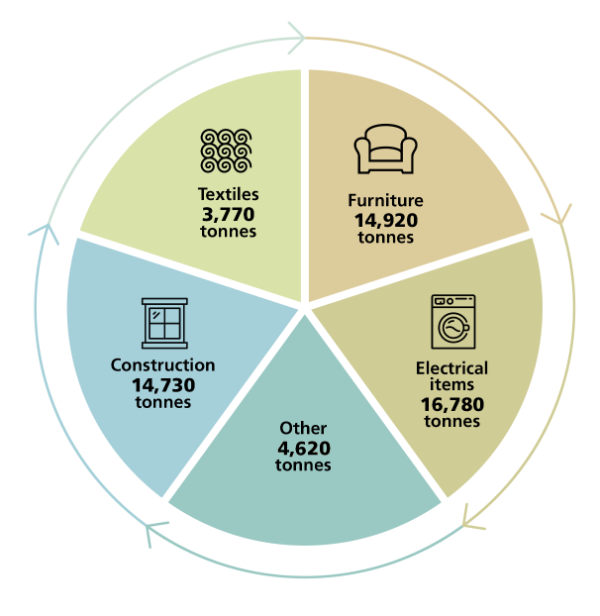
Table 1. Total weight in tonnes, of items reused in Ireland for each of the five EU reporting categories
Reuse Reporting - Quantitative Data 2021 Textiles Electrical items Furniture Construction Other Tonnes 3,771 16,778 14,915 14,729 4,615 Open in Excel: Table 1 - Total weight in tonnes of items reused in Ireland in 2021 (XLS 1KB)
Open in CSV : Table 1 - Total weight in tonnes of items reused in Ireland in 2021 (CSV 1KB)
Figure 1 shows both the total weight and the number of items reused in Ireland over a 12-month period, per EU reporting category. The graph highlights the relative difference between the weight of a category and the number of items reused in that category. The textiles category shows the highest number of items reused at 12,652,000 but the lowest total weight at 3,771 tonnes. Electronic and Electrical Equipment (EEE) items which includes a range of products from small consumer electronics up to larger household appliances such as ovens and refrigerators shows the highest total weight of 16,778 tonnes and one of the lowest total quantities of items reused at 1,392,000.
Data highlights
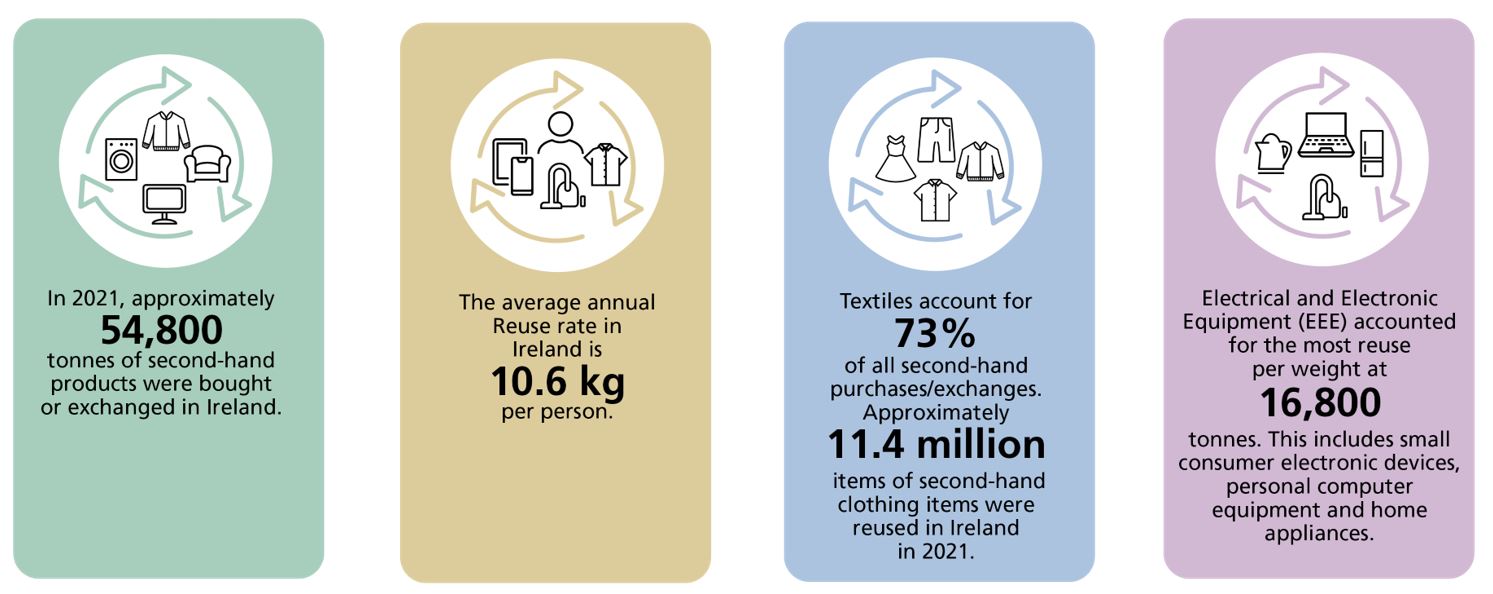
- In 2021, approximately 54,800 tonnes of second-hand products were bought or exchanged in Ireland.
- The average annual Reuse rate per person in Ireland is 10.6 kg per person.
- Textiles account for 73% of all second-hand purchases/exchanges, with approximately 11.4 million items of second-hand clothing items reused in Ireland in 2021.
- Electrical and Electronic Equipment (EEE) accounted for the most reuse per weight at approximately 16,800 tonnes. This includes small consumer electronic devices, personal computer equipment and home appliances.
The 10.6 kg per person (pp) reuse rate is based on the CSO 2022 Census population figures[1]. This is higher than the rate previously published by the 2022 EPA-funded Q2 Reuse[2] project which gave a per capita reuse value of 6.5 kg per person in 2020.
| Item / Product type |
National Population % |
Mean items per person
|
Number of items (1,000's) |
|---|---|---|---|
| Clothing | 38 | 8 | 11,413 |
| Furniture (small items) | 14 | 2 | 1,264 |
| Textiles other than clothing | 7 | 4 | 1,239 |
| Small electronics / Electrical equipment | 12 | 2 | 1,078 |
| Building material | 2 | 9 | 737 |
| Furniture (large items) | 9 | 2 | 733 |
| Large electronics / Electrical equipment | 4 | 2 | 314 |
| Tyres (car) | 2 | 3 | 229 |
| Bikes | 4 | 1 | 216 |
| Paint | 1 | 2 | 130 |
Table 2. Results from a public survey on reuse showing the percentage of the population who have bought or exchanged secondhand items across ten product categories over a 12 month period. The mean number of items per person is also shown along with the final scaled up quantities for the total population
[1] https://www.cso.ie/en/releasesandpublications/ep/p-cpr/censusofpopulation2022-preliminaryresults/
[2] https://www.epa.ie/publications/research/epa-research-2030-reports/research-405-qualifying-and-quantifying-the-reuse-sector-in-ireland.php
Reporting notes
- Qualitative data: Annual reporting on Qualitative reuse information, including reuse policies and measures, the authorities responsible for implementing these measures and targets and metrics used to track the effectiveness of reuse initiatives.
- Quantitative data: Reporting every third year (from 2021) on the quantity (in tonnes) of reuse in five specific product categories:
- Textiles
- Electronic Equipment
- Furniture
- Construction Materials
- Other products for which measures are introduced
The Qualitative review of reuse policies and measures in 2021 found that:
- There were a small number of product-specific reuse initiatives introduced including:
- Circular Textiles project, led by Community Resources Network Ireland (CRNI), which piloted separate collection methodologies for reuse of textiles.
- The Paint Reuse Network, led by the Rediscovery Centre and funded by the Regional Waste Management and Planning Offices (RWMPOs), which supports the collection of paint at civic amenity centres for remixing, repackaging and onward sale.
- Reuse was more broadly supported through general circular economy policies and measures such as:
- Green Public Procurement Guidance for the public sector by the EPA.
- Innovation & demonstration funding including the EPA’s Local Authority Prevention Network & Green Enterprise
- The Circular Economy and Innovation Grant Scheme (CEIGS) which is providing government funding towards circular economy & reuse activities including: