Lake monitoring aquatic plants - Fact Sheet
This Plain English fact sheet outlines the work done by the EPA in monitoring aquatic plants in Irish lakes., July 2020
Year: 2020
Aquatic plants are good at showing if the quality of the water is good or bad and play an important role in lake ecology by providing food and a habitat for many smaller plants, animals and birds.
Second SEA Effectiveness Review Training Event Summary
Year: 2020
This document provides a summary of the second SEA Effectiveness Review training event, held in Portlaoise on the 3rd March 2020. It captures some of the knowledge of the participants and some of the learning outcomes from the event, to assist further shared learning.
Ireland's National Inventory Submissions 2020
Year: 2020
Ireland's annual inventory submissions including the National Inventory Report (NIR) and Common Reporting Format (CRF) data files and supplementary information if available. The NIR contains transparent and detailed information on the inventory for years 1990-2018. The CRF tables contain all greenhouse gas (GHG) emissions and removals, implied emission factors and activity data.
Electromagnetic Fields, 5G and Health
Year: 2020
Electromagnetic fields or EMF are a form of non-ionising radiation, which together with optical and ionising radiation comprise the electromagnetic spectrum.
Ireland's Provisional Greenhouse Gas emissions 1990-2019
Year: 2020
The EPA has produced provisional estimates of greenhouse gas emissions for the time period 1990-2019
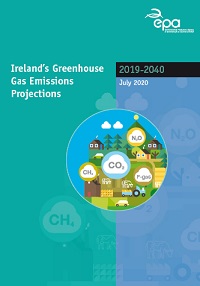
Ireland's Greenhouse Gas Emissions Projections 2019-2040
Year: 2020
This report provides an updated assessment of Ireland’s total projected greenhouse gas emissions out to 2040 which includes an assessment of progress towards achieving its emission reduction targets out to 2020 and 2030 set under the EU Effort Sharing Decision (Decision No 406/2009/EU) and Effort Sharing Regulation (Regulation (EU) 2018/842).
National Allocation Table Changes 1 2020
Year: 2020
Current National Allocation Table
Year: 2020
Ireland's UNECE Submissions 2020
Year: 2020
Ireland's submissions under UNECE Convention on Long-Range Transboundary Air Pollution (CLRTAP) and National Emissions Ceiling Directive (NECD) include the Informative Inventory Report (IIR) and Nomenclature for Reporting (NFR) tables. The IIR and NFR contain detailed information on methodologies, activity data and emission factors and emissions for years 1990-2018.
Changes to National Allocation Table New Entrant Reserve
NAT New Entrant Reserve, April 2020
Year: 2020
Estimated FDC and Mean Flow for Ungauged Catchments
Year: 2020
The development of the original HydroTool model is described initially in this report and the statistical procedures in the updated model are presented, with a re-analysis of additional and updated data. The model generates natural flow duration curves in ungauged catchments from flows at gauged catchments of similar character, using a procedure called Region of Influence which is based on catchment descriptors.
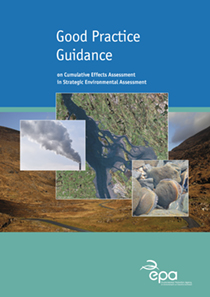
Good practice guidance on Cumulative Effects Assessment in SEA
Year: 2020
Cumulative effects result from a combination of individual effects on a receptor. They can occur as a result of plans, programmes, projects and other actions in the past, present and the reasonably foreseeable future. They can result from impacts that may be individually insignificant, but collectively significant. Cumulative effects assessment (CEA) is the process of identifying, assessing and mitigating cumulative effects.
National Waste Statistics Summary Report for 2018
Year: 2020
This report summarises EPA data on waste generation and management in Ireland in 2018. It highlights key trends and progress towards EU targets and identifies where further measures are needed to improve Ireland’s recycling rates. The report builds on information available on the EPA Waste Statistics webpages: www.epa.ie/nationalwastestatistics/
Second Review of SEA Effectiveness in Ireland
Year: 2020
The key findings and recommendations from the second review of SEA effectiveness in Ireland are presented in this report. Recommendations are included to address issues relating to guidance, training & awareness, data collection, provision & sharing and governance and legislation.
Resource Efficiency Case Studies
Resource Efficiency Case Studies, December 2019
Year: 2019
Resource Efficiency Case Studies
Guidance documents for waste statistics reporting
Waste Classification - List of Waste & Determining if Waste is Hazardous or Non-hazardous, December 2019
Year: 2019
Applicable from 5 July 2025. For additional information, please see additional documents below.
Integrating Climatic Factors into Strategic Environmental Assessment in Ireland - A Guidance Note
Year: 2019
This document is a good practice note on how to practically incorporate climatic factors into plans and programmes, which come under the scope of the SEA Directive. It provides updated climate-related information and supersedes an earlier version published in 2015. It also acknowledges recent plan and programme-related developments that have occurred since then.