Assessing impacts of atmospheric eutrophication and acidification in the Republic of Ireland (2018)
Year: 2024
A report to the Environmental Protection Agency to inform data submission under the Convention on Long-Range Transboundary Air Pollution
LIFE Emerald - Layman’s Report
Year: 2024
Nitrate Directives Article 10 Report for Ireland for the Period 2020-2023
Council Directive of 12 December 1991 concerning the protection of waters against pollution caused by nitrates from agricultural sources (91/676/EEC), August 2024
Year: 2024
This report is prepared in response to Article 10 of the Nitrates Directive (91/676/EEC). The report covers the seventh reporting period from 2020 to 2023. The report comprises: a description, with maps, of the evolution of water quality in groundwater and surface waters; a statement on the adoption of a Whole Territory Approach with respect to the designation of nitrate vulnerable zones; a summary of agricultural activities and an account of the implementation of the agricultural Code of Good Practice and a summary of the principal measures and an evaluation of the National Action Programme for limiting nitrate inputs from agricultural sources.
Water quality monitoring report on nitrogen and phosphorous concentrations in Irish waters 2023
This report provides an update on the results of water quality monitoring to support the assessment of the impact of the nitrate’s derogation on Irish waters, as required under Regulation 37 of the European Union (Good Agricultural Practices for the Protection of Waters) (Amendment) Regulations., August 2024
Year: 2024
The EPA has reported on the results of water quality monitoring to support the assessment of the impact of the nitrate's derogation on Irish Waters
NRMN Locations and Instrumentation 2024
Year: 2024
Instructions to Measure NO2
Year: 2024

Climate risk assessment approaches in the financial and commercial sectors
Authors: Dr. Christopher Phillips, Dr. Lydia Cumiskey, Cathal O’Mahony, Dr. Camila Tavares Pereira, Catriona Iulia Reid, Dr. Conor Quinlan, Dervla McAuley, Mary Frances Rochford, July 2024
Year: 2024
Focusing on lessons learned, the study explores the impact of guiding policies, legislation, and regulations on climate adaptation within the finance and commercial sectors, both internationally and nationally. The research includes a comprehensive literature review, emphasising the pivotal role of the Task Force on Climate-related Financial Disclosures (TCFD), Corporate Sustainability Reporting Directive (CSRD) and EU taxonomy frameworks in guiding climate risk assessment practices in relevant sectors. The study included interviews conducted with 20 individuals in roles related to sustainability, risk management, and Environment, Social and Governance (ESG) within 11 diverse organisations spanning finance, commercial, consultancy, and climate services sectors. The interview topics were structured around three primary themes: current practices, policy and legislation, and climate actions.
Implementation of Climate Adaptation Indicators: Lessons Learned from the Transport Sector
Authors: Dr. Ned Dwyer, Dr. Denise McCullagh and Dr. Billy O’Keeffe, July 2024
Year: 2024
Appropriate adaptation or resilience indicators provide a means to measure and quantify the status of climate adaptation, and the progress of adaptation actions in producing desired outcomes. These indicators help to define an existing situation and to track changes or trends over time. They can provide, for example, the degree of development or implementation of a policy process, or quantitative information, such as the total seasonal rainfall in a given area, or number of road bridges strengthened to withstand extreme weather events. Through a co-development process with TII, 43 adaptation indicators were identified and agreed with TII management, that are both suitable and implementable for national roads and light rail; this comprised 19 climatological, 6 impact, 11 implementation and 8 outcome indicators.
Assigning Ecological Status to Unmonitored Water Bodies in 2016-2021
A technical report outlining the methodologies used in surface waters and groundwaters, July 2024
Year: 2024
In Ireland, almost 60 per cent of identified Water Framework Directive (WFD) water bodies1 are monitored. The current ecological status assigned to these waterbodies is based on the results of the 2019-2021 national water quality monitoring programme (EPA, 2021). The status for those water bodies that are not monitored must be assigned by other means. The purpose of this technical paper is to outline how status is assigned to the remaining unmonitored surface waters and groundwaters.

Climate Change's Four Irelands: Climate Change in the Irish Mind, Wave 2, Report 2
Year: 2024
This report provides an updated overview on the Irish public’s beliefs, attitudes, policy preferences and behaviours regarding climate change in the second wave of the Climate Change in the Irish Mind study.

Ireland's Provisional Greenhouse Gas Emissions 1990-2023
Year: 2024
The EPA has produced provisional estimates of greenhouse gas emissions for the time period 1990-2023. This report provides early insight into the annual greenhouse gas emissions in advance of final data being submitted to the EU and UN in 2025.

Land Use, Land Use Change and Forestry Bulletin
Year: 2024
EPA special topic bulletin on Greenhouse Gas Emissions and Removals from Land Use, Land Use Change and Forestry (LULUCF) as part of a special topic series examining sectoral and cross-cutting climate issues. This bulletin provides an insight into the history of land use in Ireland and looks in detail at the six land use categories relevant to GHG emissions reporting. It also sheds light on Ireland’s LULUCF emissions reduction targets and on updates and revisions to the LULUCF GHG Inventory produced by the EPA.
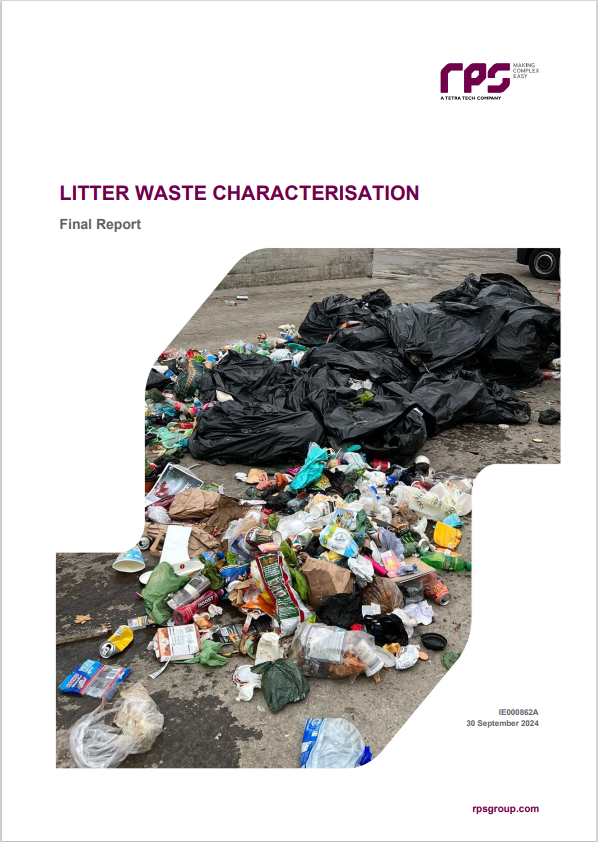
Litter Waste Characterisation Report 2024
Year: 2024
This report presents the composition of the national public litter waste in Ireland in 2024. The profile was generated from a series of physical analysis of public litter waste streams. The report profiles the following waste streams: • Public street litter bins (20 03 99A) waste is litter placed by the public in designated public waste bins. • Local Authority (LA) Street litter sweeping activities (20 03 03), includes materials from suction vehicles and manual picking. • Other litter clean-up events, including some beach clean-ups (20 03 99B), is an organised activity focused on the removal of litter from a designated area, often conducted by volunteers in a community or environmental initiative.

Water Quality in 2023
An Indicators Report, June 2024
Year: 2024
This report provides an update on the quality of water in Ireland's rivers, lakes, transitional and coastal waters and groundwater using information collected in 2023.

National Climate Change Risk Assessment Methodology Report
Methodology Report, June 2024
Year: 2024
The methodology for the Irish NCCRA has been developed through a wide engagement process in 2024. The methodology outlines the approach for the development and delivery of the NCCRA. The NCCRA will be delivered in three stages; risk identification, risk assessment and urgency and adaptation prioritisation, underpinned by a preliminary stage on scoping and context.