Latest Air reports
Research 498: Indicators of Air Pollution Effects in Ecosystems for Monitoring under the EU National Emission Reduction Commitments Directive
Authors: Thomas Cummins, Lorna Marcham and Keelan McHugh, November 2025
Year: 2025
EU member states are required to continuously monitor the state of ecosystems where negative effects of air pollution may occur, under the National Emission Commitments Directive (NEC). The NEC Indicators project led by a team in UCD reviewed indicators used to detect air pollution effects in sensitive ecosystems like bogs and semi-natural grasslands. It focused on ammonia, mainly from agriculture, and ozone, formed through chemical reactions involving industrial and transport emissions. The findings show that ozone levels are highest near Ireland’s Atlantic coast, decreasing inland and in urban areas due to deposition and chemical reactions. Researchers found that even low nitrogen inputs can significantly alter plant communities. The findings may be used to review and refine monitoring methods in the National Ecosystems Monitoring Network. Development of structures and communication within the monitoring community is encouraged.
Research 496: INHALE: Irish Nationwide Health and Air Quality Linkage
Authors: Éilis J. O’Reilly, Claire Buckley, Christina Dillon and Stig Hellebust, October 2025
Year: 2025
Outdoor air pollution is “the single biggest environmental health risk”, accounting for almost 4.2 million premature deaths in 2019 (WHO, 2024). The INHALE project, led by University College Cork, reviewed global best practices for linking air quality and health data while protecting patient confidentiality. It proposed two solutions for Ireland: investing in trusted research environment (TRE) infrastructure to securely share de-identified, individual-level data, and a researcher-led method that links pollution data to Eircodes and merges it with health records through data custodians. The INHALE project provides policymakers with greater insight and evidence to facilitate cost-effective methods to address barriers in linking air quality and health data. It recommends more investment of dedicated resources to better understand the health effects of air pollution.
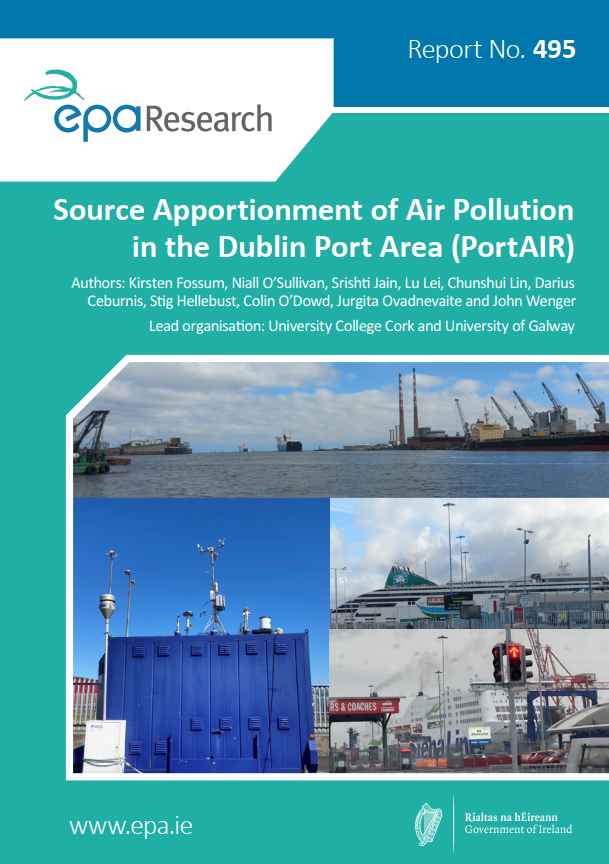
Research 495: Source Apportionment of Air Pollution in the Dublin Port Area (PortAIR)
Authors: Kirsten Fossum, Niall O’Sullivan, Srishti Jain, Lu Lei, Chunshui Lin, Darius Ceburnis, Stig Hellebust, Colin O’Dowd, Jurgita Ovadnevaite and John Wenger, October 2025
Year: 2025
Dublin Port, Ireland’s largest freight and passenger port, brings significant economic and social benefits, however emissions from ships and other port-related activities contribute to climate change and air pollution. The PortAIR project conducted the first detailed study of air quality impacts from ships and port activities using continuous monitoring and advanced modelling throughout 2022. It identified two main ship plumes: one dominated by sulfate from high-sulfur fuel with scrubbers and another by organic species from low-sulfur fuels. Ship emissions peaked during manoeuvring. With port expansion planned, emission reduction strategies are recommended, including shore-side electricity, emission control zones, battery-powered vessel and cleaner fuels. The study highlights the importance of advanced instruments for continuous air quality monitoring and recommends the need for further research into mitigation technologies.

Research 436: Assessing Potential for North Atlantic Integrated Atmospheric Research
Liz Coleman and Frank McGovern, August 2023
Year: 2023
The impact of human activity since the Industrial Revolution has altered the environment, pushing its stability to critical limits, with real implications for societal, economic and environmental systems. The planetary boundaries framework has provided a powerful tool for communicating the individual and collective threats arising from unsustainable post-industrial development, yet actions and responses take place at regional, national and local levels.
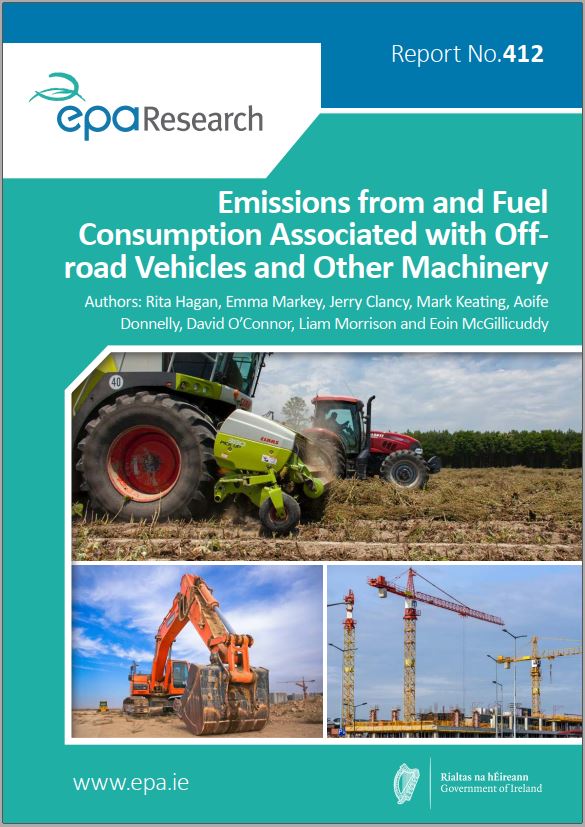
Research 412: Emissions from and Fuel Consumption Associated with Off-road Vehicles and Other Machinery
Authors: Rita Hagan, Emma Markey, Jerry Clancy, Mark Keating, Aoife Donnelly, David O’Connor, Liam Morrison and Eoin McGillicuddy, July 2022
Year: 2022
Non-road mobile machinery (NRMM) is a large category that until recently had not been widely researched in terms of its contribution of exhaust emissions to overall air pollution. The emissions from NRMM contribute significantly to air pollution. To lower emissions from NRMM and improve air quality, it is recommended that more data are collected from sectors such as rail, construction, and aviation, and from Transport Infrastructure Ireland. This research used the bottom-up approach of contacting NRMM owners and data holders to request data about their NRMM fleet and its fuel use.
Research 407: Residential Solid Fuel Use in Ireland and the Transition Away from Solid Fuels
Authors: John Eakins, Bernadette Power, Niall Dunphy and Gordon Sirr, April 2022
Year: 2022
The EPA has highlighted air quality issues in urban centres in Ireland in recent years. Emissions of fine particulate matter (PM2.5), attributable to the burning of solid fuels, such as coal, peat and wood, are a particular cause of concern. This research project aims to provide a deeper understanding of the sector using existing and new sources of data on solid fuel use. The development of a new data set based on a survey of household heating and fuel use will be the primary contribution.
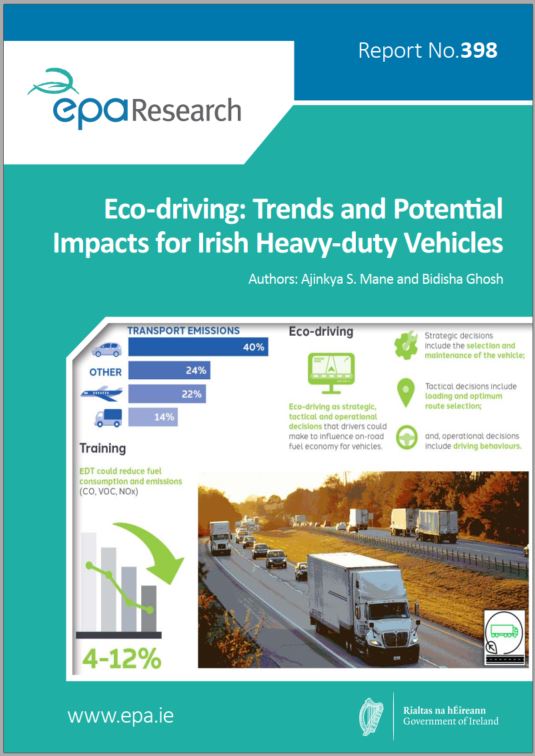
Research 398: Eco-driving: Trends and Potential Impacts for Irish Heavy-duty Vehicles
Authors: Ajinkya S. Mane and Bidisha Ghosh, December 2021
Year: 2021
The “Eco-HDV” research project evaluated the impacts of adaptation of eco-driving programmes in the Irish heavy-duty vehicle fleet, focusing especially on the freight sector. The research identified perceptions and awareness of eco-driving training, reviewed the best eco-driving practices and analysed the possibilities of adaptation of eco-driving programmes. The project generated guidelines for the implementation of eco-driving programmes and other measures to reduce vehicular emissions from the Irish heavy-duty vehicle fleet.
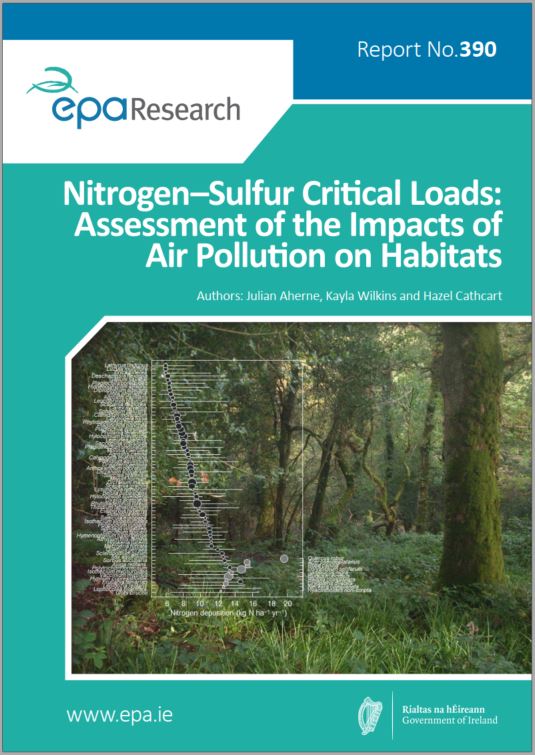
Research 390: Nitrogen–Sulfur Critical Loads: Assessment of the Impacts of Air Pollution on Habitats
Authors: Julian Aherne, Kayla Wilkins and Hazel Cathcart, September 2021
Year: 2021
Air pollution can have unacceptable impacts on the natural environment. In particular, elevated atmospheric nitrogen deposition can result in changes to the plant communities of natural and seminatural ecosystems, resulting in decreases in plant biodiversity. This project developed empirical critical loads of nutrient nitrogen for 17 Annex I habitats. The project analysis suggests that habitats within the Atlantic biogeographic region have critical loads at the low end or lower than existing UNECE recommended ranges for European habitats.
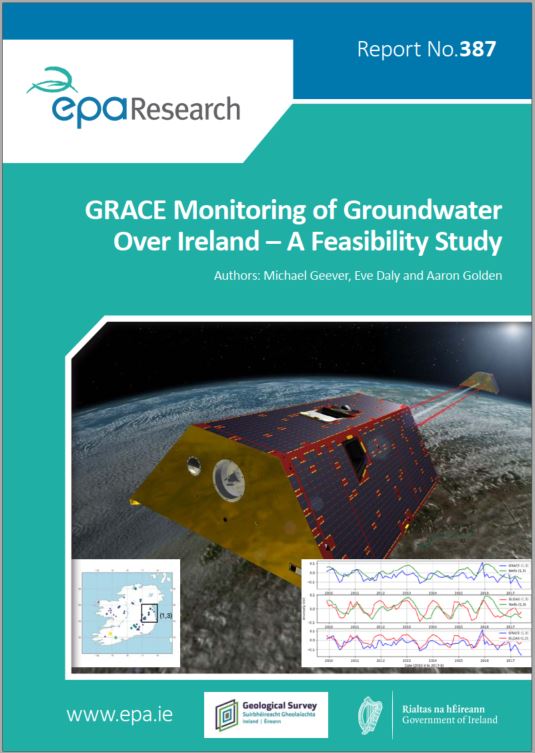
Research 387: GRACE Monitoring of Groundwater over Ireland – A Feasibility Study
Authors: Michael Geever, Eve Daly and Aaron Golden, August 2021
Year: 2021
Changing population trends, growing urbanisation and associated economic development increase pressure on our water resources. This project investigates the feasibility of using space-based observations of gravitational anomalies, obtained by NASA’s Gravity Recovery and Climate Experiment (GRACE), to assess groundwater variations at a regional level across the island of Ireland. The report fully documents ways of accessing, processing and visualising GRACE gravitational anomaly data, and outlines a means to integrate data from NASA’s land surface model with data from the EPA’s HydroNet groundwater well network.
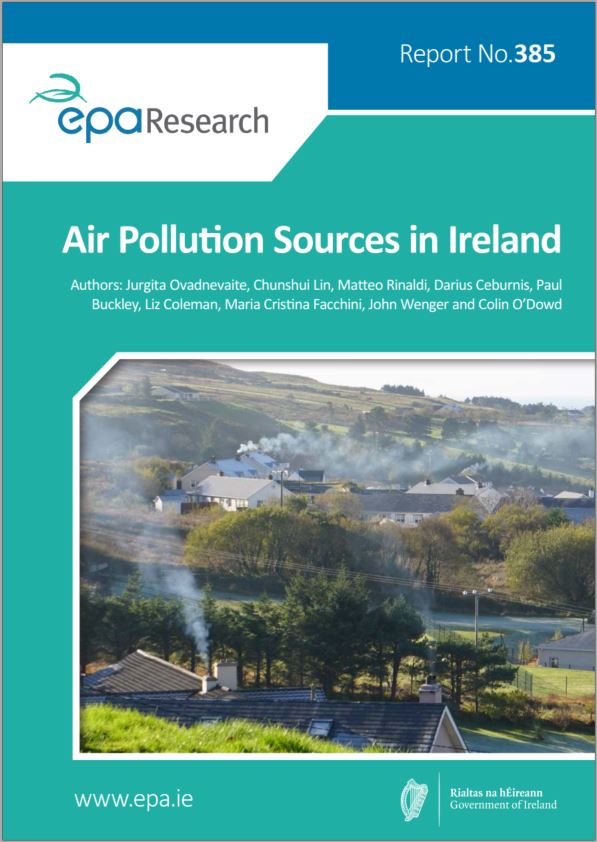
Research 385: Air Pollution Sources in Ireland
Authors: Jurgita Ovadnevaite, Chunshui Lin, Matteo Rinaldi, Darius Ceburnis, Paul Buckley, Liz Coleman, Maria Cristina Facchini, John Wenger and Colin O’Dowd, July 2021
Year: 2021
The project successfully established the AEROSOURCE network, comprising three sophisticated aerosol mass spectrometer nodes positioned in strategic locations: Carnsore Point (regional background), Dublin (urban environment) and Mace Head (marine background). It enhanced the National Transboundary Air Pollution Network with near real-time aerosol chemical speciation (including organic matter) and source apportionment capabilities.
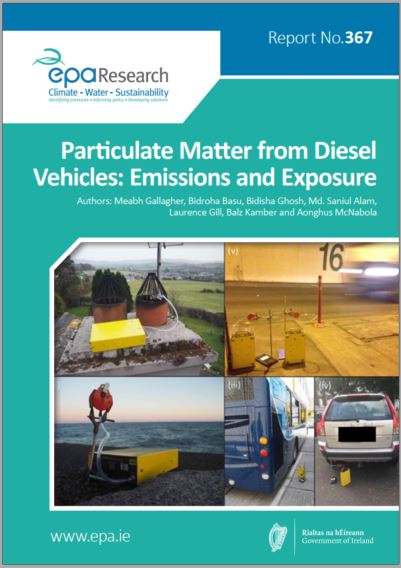
Research 367: Particulate Matter from Diesel Vehicles: Emissions and Exposure
Authors: Meabh Gallagher, Bidroha Basu, Bidisha Ghosh, Md. Saniul Alam, Laurence Gill, Balz Kamber and Aonghus McNabola, February 2021
Year: 2021
Research was conducted to assess the contribution of diesel vehicle emissions to the concentrations of PM2.5 in Dublin. The major source identified was solid fuel burning, contributing 46-50% of the total mass recorded. The 2nd largest contributor at a roadside site was diesel vehicle emissions (22%) followed closely by road dust (19%). The 2nd largest source at a suburban site was soil (20%) followed closely by sea spray (14%).
Research 365: Developing Ireland’s Greenhouse Gas and Transboundary Air Pollution Monitoring Network
Authors: Damien Martin and Colin O’Dowd, January 2021
Year: 2021
The Atmospheric Composition and Climate Change (AC3) network is an established national research and monitoring infrastructure developed incrementally. It monitors greenhouse gases, short-lived climate forcers, and aerosol chemical and physical characteristics in line with best practice from pan-European and global monitoring programmes. This fellowship has enabled and sustained scientific operations for a national monitoring network.
Research 357: Ireland’s Atmospheric Composition and Climate Change Network
Authors: Damien Martin and Colin O’Dowd, November 2020
Year: 2020
The Atmospheric Composition and Climate Change network is a valuable established national research and monitoring infrastructure. This fellowship has enabled and sustained scientific work on a national monitoring network. Infrastructure has been continually developed over the course of the fellowship that will facilitate long-term sustainable measurements.
Research 325: Sourcing and Assessing Agricultural Activity Data for Modelling and National Estimates of Greenhouse Gases and Air Pollutants
Author: Mohammad Ibrahim Khalil, July 2020
Year: 2020
This project aimed to inform efforts at combating climate change as a core national priority in the pursuit of a sustainable, low carbon economy in compliance with international obligations to reduce emissions of greenhouse gases (GHGs) and air pollutants and increase soil organic carbon (SOC) sequestration.
Research 319: Remote Sensing of Aerosols, Clouds and Wind at Mace Head Atmospheric Research Station
Authors: Jana Preißler and Colin O’Dowd, July 2020
Year: 2020
The power of remote sensing lies in its ability to automatically and continuously characterise parts of the atmosphere that can be far away from the sensor, e.g. at high altitudes from the ground in the case of this study. This fellowship focused on continuous high-resolution (vertical and temporal) profiling of the atmosphere over Mace Head Atmospheric Research Station using active and passive ground-based remote sensing techniques.

Research 318: Source Apportionment of Particulate Matter in Urban and Rural Residential Areas of Ireland (SAPPHIRE)
In this research project, the contribution of residential solid fuel burning to ambient levels of wintertime PM2.5 was determined in the towns of Killarney, Enniscorthy and Birr. The results show that the burning of peat, coal and wood for home heating is by far the largest source of PM2.5 air pollution in these locations., June 2020
Year: 2020
In this research project, the contribution of residential solid fuel burning to ambient levels of wintertime PM2.5 was determined in the towns of Killarney, Enniscorthy and Birr. The results show that the burning of peat, coal and wood for home heating is by far the largest source of PM2.5 air pollution in these locations.
Research 317: MapEIre: National Mapping of Greenhouse Gas and Non-greenhouse Gas Emissions Sources Project.
Authors: Ole-Kenneth Nielsen, Marlene S. Plejdrup, Henrik G. Bruun, Steen Gyldenkærne and Jesper H. Christensen, May 2020
Year: 2020
This research developed a state-of-the-art integrated model system to map emissions for Ireland’s emission inventories of air pollutants and greenhouse gases. Based on a variety of spatial and statistical data, the MapEIre model produced detailed spatial emissions at a resolution of 1 km × 1 km.
Research 303: Research Support for Integrated Atmospheric Studies at Mace Head
Authors: Darius Ceburnis, Colin D. O’Dowd, Stephen G. Jennings and Margaret Ryan, December 2019
Year: 2019
This fellowship project supports extensive research efforts on particulate matter (PM) studies in Ireland and at Mace Head station, particularly for building a knowledge base and establishing and sustaining long-term measurement series at the station.
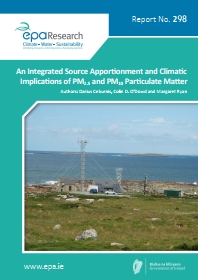
Research 298: An Integrated Source Apportionment and Climatic Implications of PM2.5 and PM10 Particulate Matter
Authors: Darius Ceburnis, Colin D. O’Dowd and Margaret Ryan, November 2019
Year: 2019
This fellowship enabled and sustained scientific operations at Mace Head Atmospheric Research Station. The advanced method of dual carbon isotope analysis will allow better identification of natural and anthropogenic source contributions, which is essential for quantifying human-induced global climate change.

Research 276: EU ETS and Competitiveness of Irish Industry
Authors: Celine McInerney, Ellen O’Connor, Bernadette Power, Paul Deane and Tom McDermott , May 2019
Year: 2019
Reforms to the European Union Emissions Trading Scheme (EU ETS) in Phase IV create a potential risk to industrial competitiveness in the power generation and heavy industry sectors through increased costs. The costs may be directly linked to greenhouse gas (GHG) emissions via European Union Allowances (EUAs) or may be indirect via increased energy costs.