LIFE Emerald Infographic
Year: 2023
LIFE Emerald Poster
Year: 2023
Ireland's Air Pollutant Emissions 2021 (1990-2030)
Year: 2023
Latest report (2023) on Ireland's National Emission Reduction Commitment Directive (NECD) emissions. Five main air pollutants, NOx, SO2, NH3, NMVOC and PM2.5
Note of land evidence forum meeting, 17 April 2023
Year: 2023
Note of land evidence forum meeting, 17 April 2023
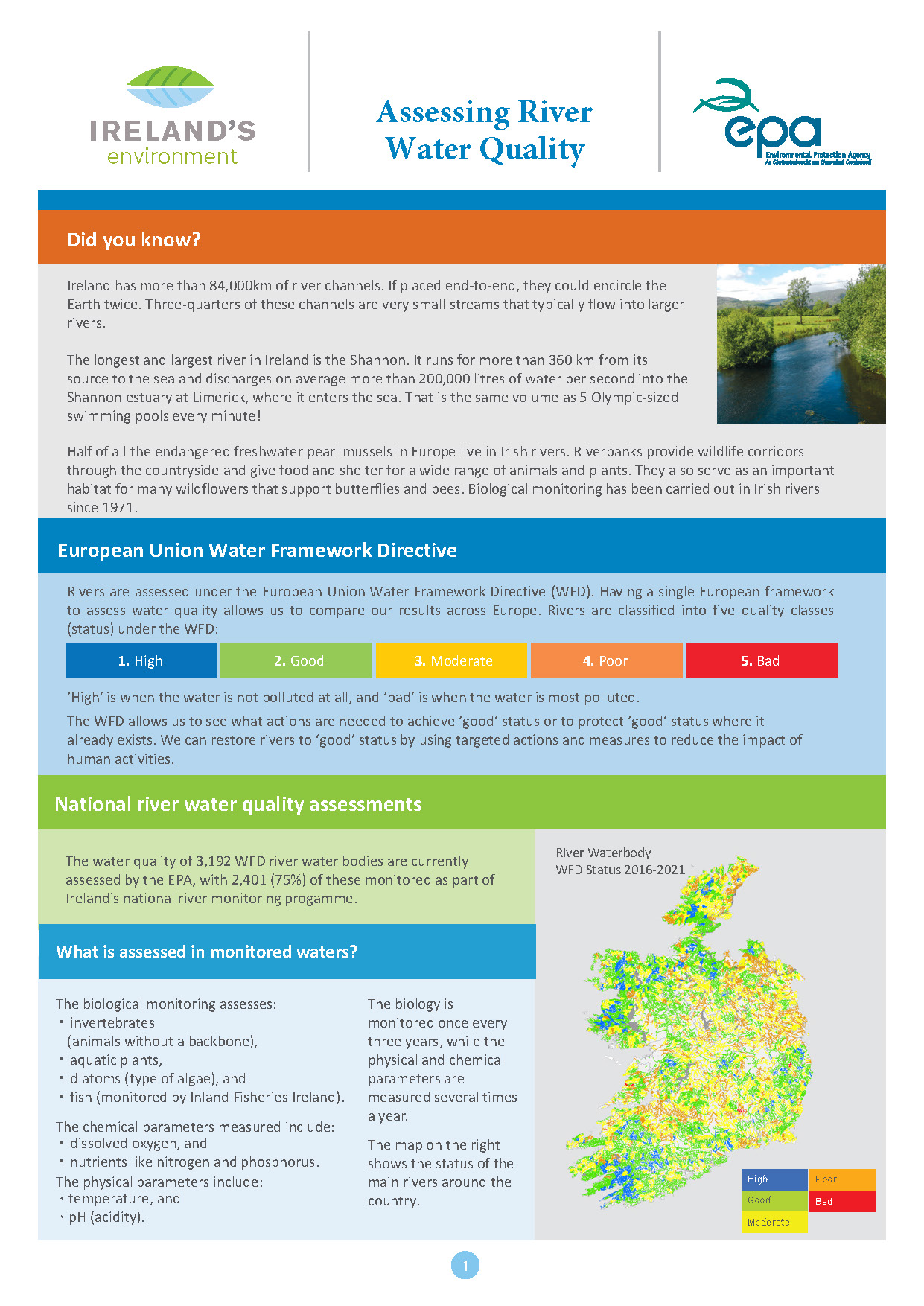
Assessing river water quality - EPA fact sheet
This Plain English fact sheet outlines the work done by the EPA in monitoring and assessing Ireland’s rivers. , April 2023
Year: 2023
Ireland has more than 73,000 km of river channels. If placed end-to-end, they could encircle the Earth almost twice. Three-quarters of these channels are very small streams that typically flow into larger rivers.
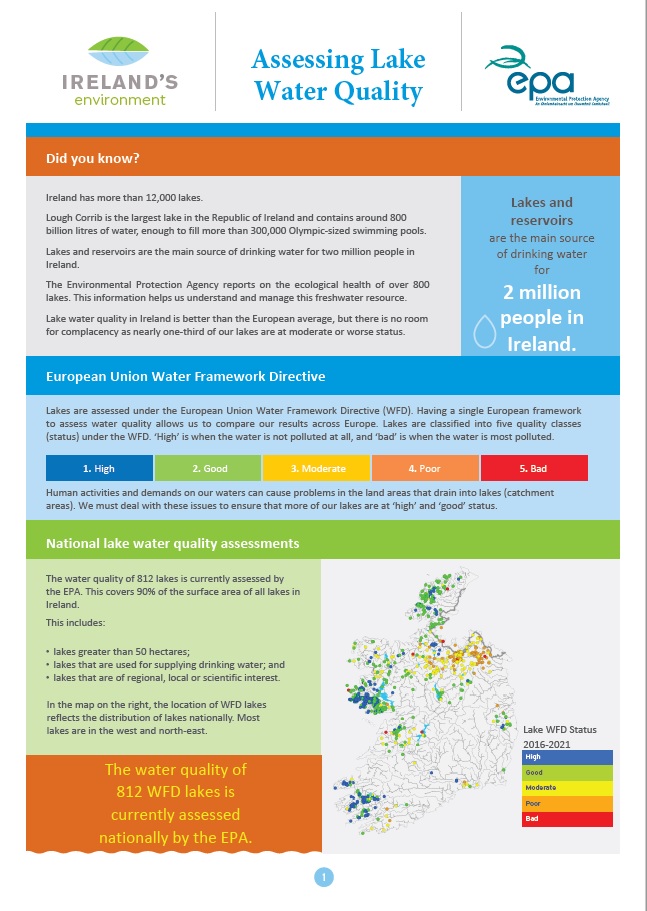
Assessing lake water quality - EPA fact sheet
This Plain English fact sheet outlines the work done by the EPA in assessing water quality in Ireland’s lakes. , April 2023
Year: 2023
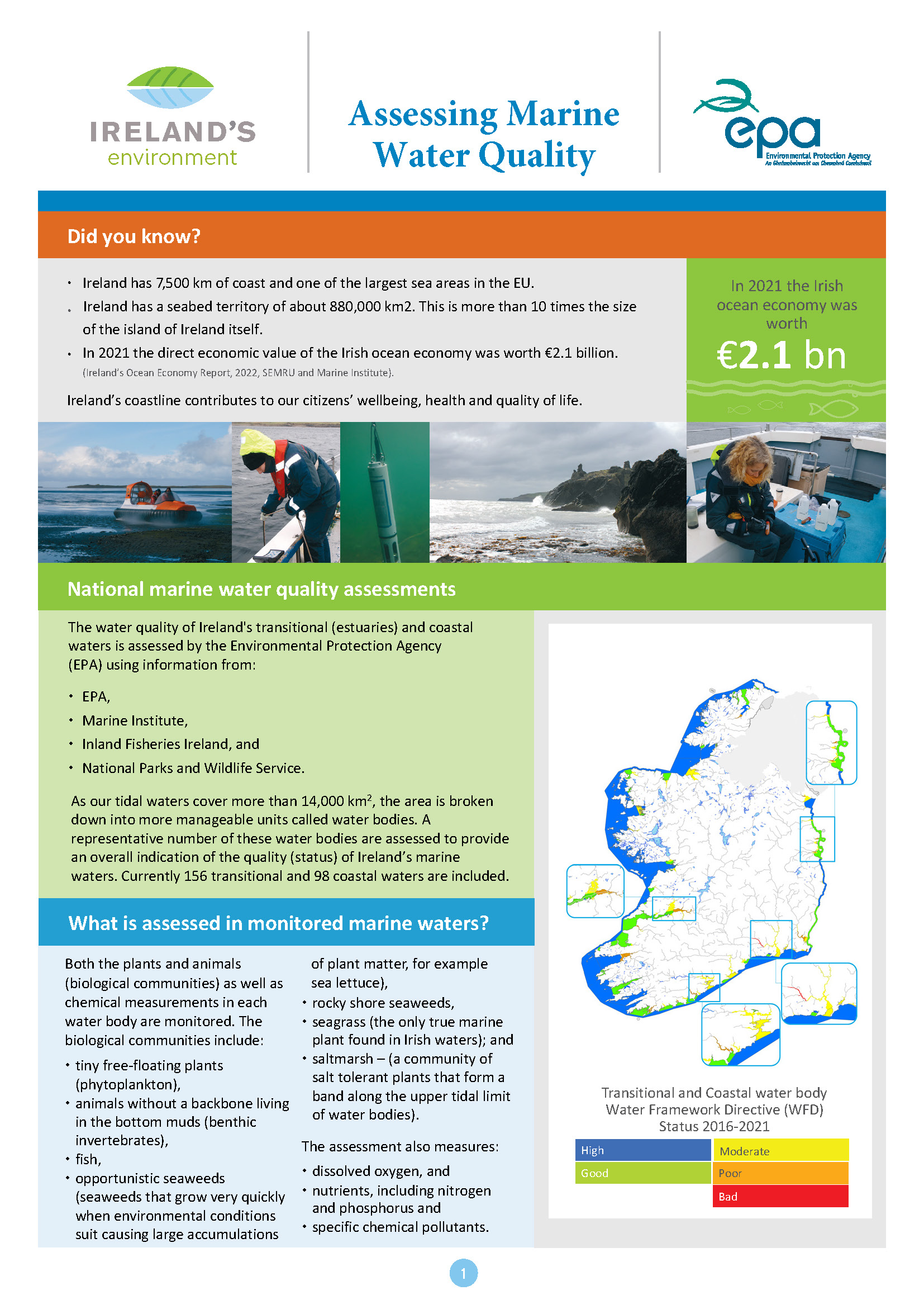
Assessing marine water quality - EPA fact sheet
This Plain English fact sheet outlines the work done by the EPA in monitoring and assessing Ireland’s marine environment. , April 2023
Year: 2023
Ecologically healthy marine waters are a valuable natural resource. They support a rich and diverse range of ecosystems, habitats and species, and they are also a source of food – from wild fisheries and aquaculture. They are also important for recreational activities and tourism.
Ireland's Final Greenhouse Gas Emissions 1990-2021
Year: 2023
The EPA has produced final estimates of greenhouse gas emissions for the time period 1990-2021
Radiofrequency electromagnetic fields in public spaces in Ireland
Results of the Radio Frequency Electromagnetic Fields Monitoring Programme 2021-2022, March 2023
Year: 2023
Ireland's National Inventory Submissions 2023
Year: 2023
Ireland's annual inventory submissions including the National Inventory Report (NIR) and Common Reporting Format (CRF) data files and supplementary information if available. The NIR contains transparent and detailed information on the inventory for years 1990-2021. The CRF tables contain all greenhouse gas (GHG) emissions and removals, implied emission factors and activity data..
Ireland's UNECE Submissions 2023
Year: 2023
Ireland's submissions under UNECE Convention on Long-Range Transboundary Air Pollution (CLRTAP) and National Emissions Ceiling Directive (NECD) include the Informative Inventory Report (IIR) and Nomenclature for Reporting (NFR) tables. The IIR and NFR contain detailed information on methodologies, activity data and emission factors and emissions for years 1990-2021.
PFOA concentration of selected foams
Year: 2023
Eionet Ireland Network Brochure 2023
Year: 2023
National Focal Points (NFPs) are the primary national contact points in the EIONET and the EEA works closely with them. Typically based in a national environment agency or environment ministry, an NFP is appointed by their EEA member country. The Environmental Protection Agency acts as the NFP for Ireland, coordinating environmental information exchange with the EEA and others. In its NFP role, the EPA maintains and develops the national network. It also facilitates and coordinates contacts, requests and deliveries between national and EU level. [February 2023]
Cáilíocht an Aeir in Éirinn
Tuarascáil 2021, January 2023
Year: 2023
Achoimre: Tá cáilíocht an aeir in Éirinn go maith go ginearálta, ach tá ceisteanna áitiúla imníoch a bhfuil tionchar diúltach acu ar an aer a análaimid. Chomhlíon Éire a riachtanais dhlíthiúla uile AE í 2021, ach níor chomhlíon sí na treoirlínte nua WHO bunaithe ar shláinte í 2021. Ba cheart d’Éirinn agus don Eoraip bogadh i dtreo treoirlínte cáilíochta aeir WHO atá bunaithe ar shláinte a bhaint amach.
Note of land evidence forum meeting, 19 January 2023
Year: 2023
Land evidence forum meeting notes 19 January 2023

Guidance on SEA Statements and Monitoring
Year: 2023
This report is an update of the previous stand-alone guidance document on SEA Statements and monitoring, prepared as part of the EPA-funded project Second Review of SEA Effectiveness in Ireland (González et al., 2020). It is specific to the Irish context but has wider international applicability. The monitoring recommendations include guidance on indicators to facilitate a more consistent and coherent approach at this SEA stage. The updates relate to clarifying some SEA monitoring requirements and to acknowledge the published revised national SEA Guidelines and the Development Plan Guidelines for Planning authorities, both published by the DHLGH in 2022.