Latest Research Publications
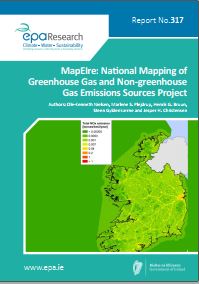
Research 317: MapEIre: National Mapping of Greenhouse Gas and Non-greenhouse Gas Emissions Sources Project.
Authors: Ole-Kenneth Nielsen, Marlene S. Plejdrup, Henrik G. Bruun, Steen Gyldenkærne and Jesper H. Christensen, May 2020
Year: 2020
This research developed a state-of-the-art integrated model system to map emissions for Ireland’s emission inventories of air pollutants and greenhouse gases. Based on a variety of spatial and statistical data, the MapEIre model produced detailed spatial emissions at a resolution of 1 km × 1 km.
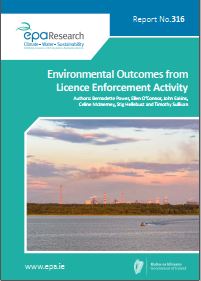
Research 316: Environmental Outcomes from Licence Enforcement Activity
Authors: Bernadette Power, Ellen O’ Connor, John Eakins, Celine McInerney, Stig Hellebust and Timothy Sullivan, May 2020
Year: 2020
The ultimate objective of environmental regulation is the prevention and reduction of environmental harm from pollution, habitat loss and resource depletion. The findings from this research provide an update of current practices and recent changes introduced in some jurisdictions.

Research 315: Activity Data for Emissions of Non-methane Volatile Organic Compounds
Authors: Stephen Barry and Bernadette O’Regan, April 2020
Year: 2020
Non-methane volatile organic compound (NMVOC) emissions from Solvent and Other Product Use have been estimated for 2006–2012. This included updating the activity data, emission factors and emissions data and compiling this information into a national emissions estimate for the specified years.

Research 314: Deepening Public Engagement on Climate Change: Lessons from the Citizens’ Assembly
Authors: Laura Devaney, Diarmuid Torney, Pat Brereton and Martha Coleman, April 2020
Year: 2020
The Irish Citizens’ Assembly afforded 99 citizens the time, space and structure to deliberate on some of the most important issues facing Irish society and politics. The 13 climate recommendations agreed on by the citizens in consideration of “How the State can make Ireland a leader in tackling climate change” were significantly more radical than many expected. They encompassed a suite of sectors, solutions and policy actions.
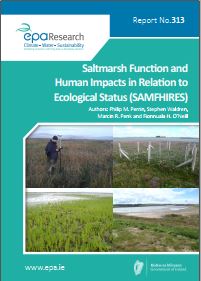
Research 313: Saltmarsh Function and Human Impacts in Relation to Ecological Status (SAMFHIRES)
Authors: Philip M. Perrin, Stephen Waldren, Marcin R. Penk and Fionnuala H. O’Neill , April 2020
Year: 2020
Coastal saltmarshes provide a range of important ecosystem services but face increasing challenges because of human activities. Ecological assessments of saltmarshes are required to inform reporting in compliance with the European Union (EU) Habitats Directive (HD) (92/43/EEC) and Water Framework Directive (WFD) (2000/60/EC).
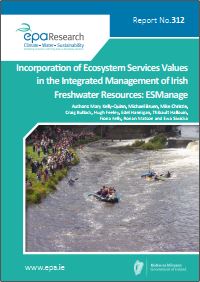
Research 312: Incorporation of Ecosystem Services Values in the Integrated Management of Irish Freshwater Resources: ESManage
Authors: Mary Kelly-Quinn, Michael Bruen, Mike Christie, Craig Bullock, Hugh Feeley, Edel Hannigan, Thibault Hallouin, Fiona Kelly, Ronan Matson and Ewa Siwicka, April 2020
Year: 2020
The ESManage project tested an eight-step methodological framework to help embed ecosystem services and the ecosystem services approach into policy and decision-making for the sustainable management of water resources, as required by the Water Framework Directive (WFD).
Research 311: Behavioural Change Tools to Promote Going Beyond Compliance in the Regulated Community
Authors: Niall Keely, Myles Kingston and Ken Stockil, April 2020
Year: 2020
The environmental compliance and enforcement landscape has evolved significantly over the last number of decades, with policy and legislation serving as a key driver. The nuances and complexities of compliance and enforcement have also evolved, as they now require a better understanding of the barriers and challenges, drivers and incentives, and the behavioural and contextual factors at play among regulated communities.
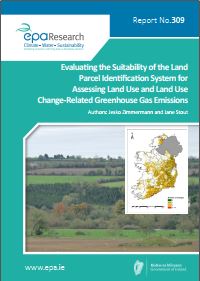
Research 309: Evaluating the Suitability of the Land Parcel Identification System for Assessing Land Use and Land Use Change-Related Greenhouse Gas Emissions
Authors: Jesko Zimmermann and Jane Stout, March 2020
Year: 2020
Land use and land use change have a significant impact on national greenhouse gas (GHG) emissions and are therefore an integral part of national GHG reporting, as laid out by the United Nations Framework Convention on Climate Change. In Ireland, land use and land use change reporting is currently based on total national agricultural area data provided by the Central Statistics Office.
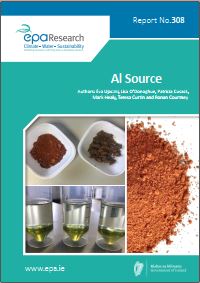
Research 308: Al Source
Authors: Éva Ujaczki, Lisa O’Donoghue, Patricia Cusack, Mark Healy, Teresa Curtin and Ronan Courtney, March 2020
Year: 2020
The scope of the Al Source project is to determine the optimisation of state-of-the-art technologies that could offer potential in the reuse of bauxite residue to recover valuable elements.
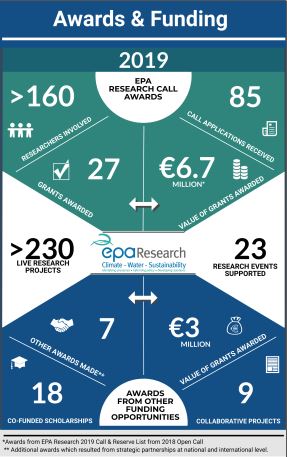
EPA Research Infographic: 2019 in Numbers
Year: 2020
This infographic gives information about the EPA research programme in 2019
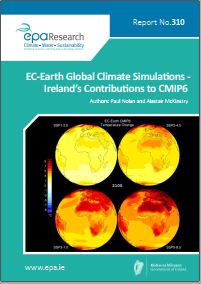
Research 310: EC-Earth Global Climate Simulations: Ireland’s Contributions to CMIP6
Authors: Paul Nolan and Alastair McKinstry , March 2020
Year: 2020
This report provides an overview of future global climate projections as simulated by the EC-Earth Earth system model. The global climate simulations described in this report constitute Ireland’s contribution to the Coupled Model Intercomparison Project (CMIP) (phase 6) (CMIP6) and will be included for assessment in the United Nations Intergovernmental Panel on Climate Change (IPCC) Sixth Assessment Report (AR6)
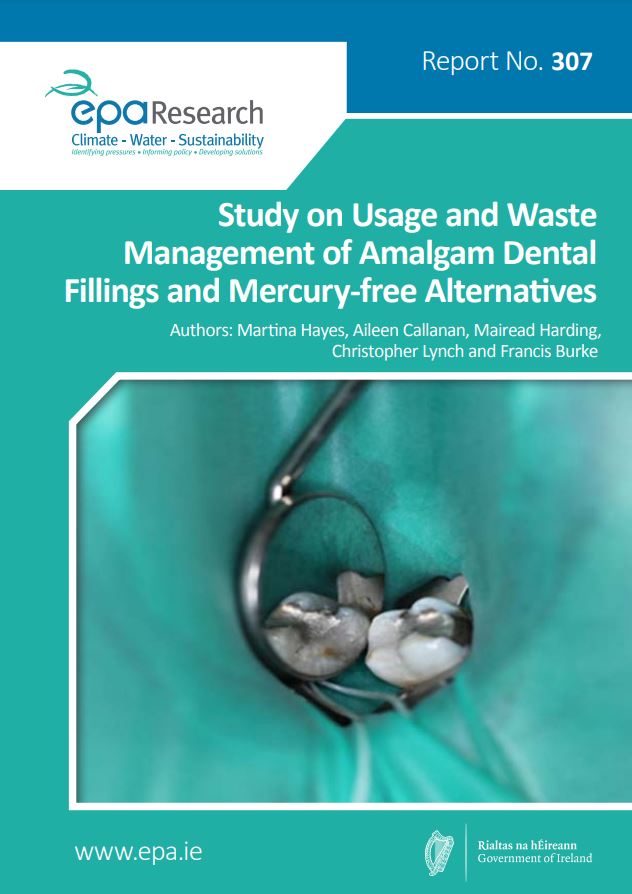
Research 307: Study on Usage and Waste Management of Amalgam Dental Fillings and Mercury-free Alternatives
Authors: Martina Hayes, Aileen Callanan, Mairead Harding, Christopher Lynch and Francis Burke, February 2020
Year: 2020
The filling of teeth is one of the most routine and common tasks undertaken by dentists. Because of the availability of community fluoridation and improved dental care, Irish adults have fewer missing teeth; however, they have more teeth with fillings.
Research 306: Second Review of Strategic Environmental Assessment Effectiveness in Ireland
Authors: Ainhoa González, Riki Therivel, Antonia Gaughran and Craig Bullock, January 2020
Year: 2020
The SEA Directive aims to integrate environmental considerations into planning and decision- making, with a view to promoting sustainable development. However, the extent to which the findings of environmental assessments are informing decisions is not fully understood. This report presents the findings of the second review of Strategic Environmental Assessment (SEA) effectiveness in Ireland.
EPA Research Strategy 2030 - Discussion Document
Year: 2020
This Discussion Document is the basis for the first phase of the Consultation Process where feedback / comments are sought on the proposed directions of the new EPA Research Strategy.
Research 305: BRIAR: Biomass Retrieval in Ireland using Active Remote sensing
Authors: Stuart Green, Shafique Martin, Saeid Gharechelou, Fiona Cawkwell and Kevin Black, December 2019
Year: 2019
Hedgerows are an important feature of the Irish landscape. They perform multiple functions, acting as boundary markers, reservoirs of biodiversity, controlling run-off and they store carbon in above-ground biomass. The purpose of this study was to examine the use of an active remote sensing tool, imaging radar, to estimate biomass in hedgerows.
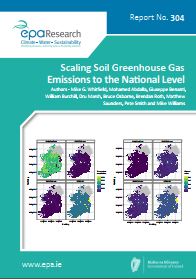
Research 304: Scaling Soil Greenhouse Gas Emissions to the National Level
Authors: Mike G. Whitfield, Mohamed Abdalla, Giuseppe Benanti, William Burchill, Dru Marsh, Bruce Osborne, Brendan Roth, Matthew Saunders, Pete Smith and Mike Williams, December 2019
Year: 2019
This project was concerned with improving the national inventory of GHG emissions from Irish soils. The IPCC's Tier 2 and 3 methodologies were used, effectively upscaling regional data on N2O and CO2 to the national level, through a combined process-based model and geographic information system (GIS) approach.

Research 302: Fossil Fuel Lock-in in Ireland: How Much Value Is at Risk?
Authors: Celine McInerney, Conor Hickey, Paul Deane, Joseph Curtin and Brian Ó Gallachóir, December 2019
Year: 2019
The European emissions reduction policy is clear and calls for the energy sectors, particularly the electricity sector, to be carbon neutral before 2050. The objective of this study is to examine how the decarbonisation of the power system will impact the investment case for both electricity generation and infrastructure assets.
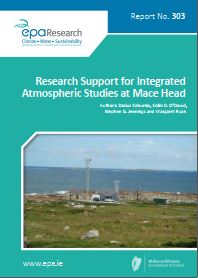
Research 303: Research Support for Integrated Atmospheric Studies at Mace Head
Authors: Darius Ceburnis, Colin D. O’Dowd, Stephen G. Jennings and Margaret Ryan, December 2019
Year: 2019
This fellowship project supports extensive research efforts on particulate matter (PM) studies in Ireland and at Mace Head station, particularly for building a knowledge base and establishing and sustaining long-term measurement series at the station.
Research 301: Adaptive Responses to Climate Impacts (ARC)
Authors: Justin Doran, Thomas McDermott, Paul Kilgarriff, Swenja Surminski and Mauricio Perez Alaniz, November 2019
Year: 2019
Climate change is likely to lead to physical changes in temperature and precipitation and sea level rise, and Ireland is already experiencing the effects of climate change on its weather patterns. This project identifies several interacting factors that should be considered in designing efficient climate change adaptation strategies.
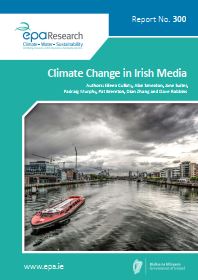
Research 300: Climate Change in Irish Media
Authors: Eileen Culloty, Alan Smeaton, Jane Suiter, Padraig Murphy, Pat Brereton, Dian Zhang and Dave Robbins , November 2019
Year: 2019
Research indicates that public concern about climate change is largely derived from media consumption. This project investigated coverage trends on climate change across print, broadcast and online media in order to make recommendations for climate change communicators.