Latest Research Publications
STRIVE 119 - Safer Acid Catalysts
STRIVE 119 - Nick Gathergood, December 2013
Year: 2013
This report details our progress towards the development of safer, less toxic and biodegradable chemicals called acid catalysts.
STRIVE 111 - New approaches to renewable energy
STRIVE 111 - Dr Mary Pryce, Prof. Han Vos, Jennifer Manton, Suraj Soman, Avishek Paul, Prof. Sven Rau, December 2013
Year: 2013
The project has demonstrated the first step towards the development of a green approach to CO2 reduction and recycling, and delivers a technology where hydrogen can be produced from water at room temperature.
Research 131: Bridging the gap between science and policy
Year: 2013
Bridging the gap between science and policy
Research 132 - Bridging the gap between science and policy
Year: 2013
BRIDGE: Good Practice Guide for science-policy communication
Research 133 - Bridging the gap between science and policy
Year: 2013
Knowledge Transfer Guide for Researchers
Revised Terms of Reference for a Programme of Research on Environmental Impacts of Unconventional Gas Exploration & Extraction
Revised Terms of Reference (Appendix 1 of the Invitation to Tender) for a Programme of Research on Environmental Impacts of Unconventional Gas Exploration & Extraction, November 2013
Year: 2013
Revised Terms of Reference (Appendix 1 of the Invitation to Tender)
What You Said and How We’ve Responded
Public Consultation on proposed Terms of Reference for a Programme of Research on Environmental Impacts of Unconventional Gas Exploration & Extraction, November 2013
Year: 2013
Summary report of the major issues that were raised by the submissions and an explanation as to how the EPA have responded to them
Invitation to Tender - Research on Environmental Impacts of Unconventional Gas Exploration & Extraction
Invitation to Tender - Research on Environmental Impacts of Unconventional Gas Exploration & Extraction, November 2013
Year: 2013
Invitation to Tender - Research on Environmental Impacts of Unconventional Gas Exploration & Extraction
Small Scale Study: Guidance on the beneficial use of dredging material
Dr Joseph Harrington & Gary Smith, November 2013
Year: 2013
This report provides guidance on the beneficial use of dredge material in Ireland. It provides information on dredge material characterisation, best international practice in dredge material management, a summary of current practice in Ireland and guidance on the relevant governing legislation.
Summary of findings: STRIVE 107 - Biodegradable Plastic from Farm-waste Plastic
Year: 2013
This summary report highlights the achievements of this project, which demonstrated the development of a technology for the conversion of post-consumer (farm) plastic into a biodegradable plastic.
Regional-Scale Assessment of Submarine Groundwater Discharge Using Remote Sensing
Development of Remote Sensing as a Tool for Detection, Quantification and Evaluation of Submarine Groundwater Discharge (SGD) to Irish Coastal Waters, October 2013
Year: 2013
Recent advances in remote sensing provide an affordable tool with which to evaluate contamination of coastal waters from Submarine Groundwater Discharge (SGD).
Resource-efficient Ireland – Biodegradable Plastic from Farm-waste Plastic
Year: 2013
This project looks at upcycling waste plastic from Irish farms to a more valuable biodegradable form of plastic.
[1].jpg)
SIMBIOSYS: Sectoral Impacts on Biodiversity and Ecosystem Services
Year: 2013
The SIMBIOSYS Project investigated the impacts that human activity have on biodiversity and ecological functioning, and the associated benefits of biodiversity to human society, that is, ecosystem services.
Water Joint Programming Initiative Pilot Call Pre-Announcement
REVISED Version, September 2013
Year: 2013
This Pilot Call for proposals aims to enable multi-national, collaborative research, development and innovation projects addressing the topic “Emerging water contaminants – anthropogenic pollutants and pathogens”.
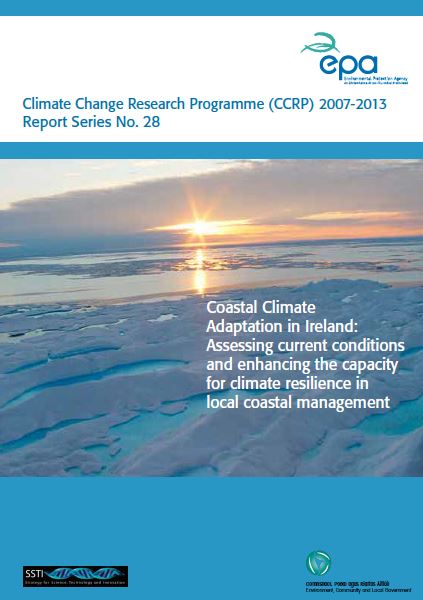
Coastal Climate Adaptation in Ireland
Assessing current conditions and enhancing the capacity for climate resilience in local coastal management. Climate Change Research Report Programme (CCRP) 2007 - 2013 Report Series No. 28, September 2013
Year: 2013
Looks at adaptation options and responses in the Cork area.
Winners and Losers: Climate Change Impacts on Biodiversity in Ireland
Climate Change Research Programme (CCRP) 2007 - 2013 Report Series No. 19, September 2013
Year: 2013
Research report on climate change impacts on Biodiversity in Ireland, projecting changes and informing adaptation measures
Current and Future Vulnerabilities to Climate Change in Ireland
Climate Change Research Programme (CCRP) 2007 - 2013 Report Series No. 29, September 2013
Year: 2013
Further research is required to identify critical thresholds or adaptation tipping points. The study recommends a fuller climate change risk assessment to better inform adaptation options.
HydroDetect
Climate Change Research Programme (CCRP) 2007 - 2013 Report Series No. 27, September 2013
Year: 2013
The work capitalises on the rich history and strengths of hydrometric monitoring and data collection conducted by the Environmental Protection Agency, the Office of Public Works and Local Authorities. The report provides analysis of signals of climate change in these data.
Ireland's National Phenology Network (IE-NPN)
Climate Change Research Programme (CCRP) 2007 - 2013 Report Series No. 23, September 2013
Year: 2013
The study links increasing air temperature, particularly in Spring, to the earlier emergence of leaves which contributes to a longer growing season. However, trends in autumn, towards later leaf fall for example, were much less obvious possibly as day-length is a stronger environmental cue than temperature.
Climate Change Impacts on Phenology: Implications for Terrestrial Ecosystems
Climate Change Research Programme (CCRP) 2007 - 2013 Report Series No. 22, September 2013
Year: 2013
The study links increasing air temperature, particularly in Spring, to the earlier emergence of leaves which contributes to a longer growing season. However, trends in autumn, towards later leaf fall for example, were much less obvious possibly as day-length is a stronger environmental cue than temperature.