Latest Research Publications
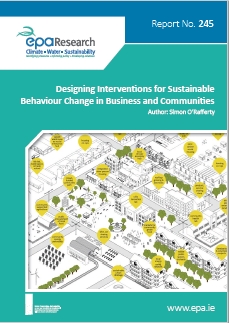
Research 245: Designing Interventions for Sustainable Behaviour Change in Business and Communities
Author: Simon O’Rafferty, May 2018
Year: 2018
Sustainable consumption and production demands behaviour changes. Policymakers and regulators already apply a range of interventions and incentives with a view to changing individual and organisational behaviour. This includes fiscal incentives, subsidies, pricing mechanisms and market-based instruments, standards, eco-labels and communication, business support programmes and curriculum development.
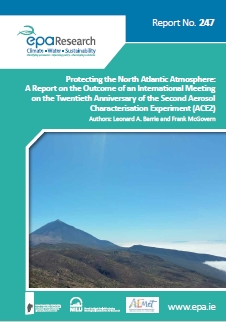
Research 247: Protecting the North Atlantic Atmosphere: A Report on the Outcome of an International Meeting on the Twentieth Anniversary of the Second Aerosol
Authors: Leonard A. Barrie and Frank McGovern, May 2018
Year: 2018
The North Atlantic Ocean is flanked by four major continental regions, and is impacted by emissions from these regions, including those from the major conurbations and industrial regions, as well as by emissions from intercontinental and regional transport systems.
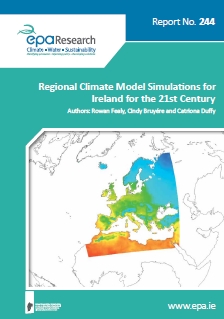
Research 244: Regional Climate Model Simulations for Ireland for the 21st Century
Authors: Rowan Fealy, Cindy Bruyére and Catriona Duffy, May 2018
Year: 2018
The model simulations represent Ireland’s contribution to the European component of the Coordinated Regional Downscaling Experiment (EURO-CORDEX), a World Climate Research Programme (WCRP) initiative to address climate information needs at the regional level.
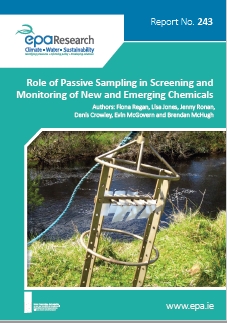
Research 243: Role of Passive Sampling in Screening and Monitoring of New and Emerging Chemicals
Authors: Fiona Regan, Lisa Jones, Jenny Ronan, Denis Crowley, Evin McGovern and Brendan McHugh, April 2018
Year: 2018
Passive sampling (PS) techniques are rapidly developing as very cost-effective state-of-the-art tools for identifying and measuring ultra-trace micropollutants in water.
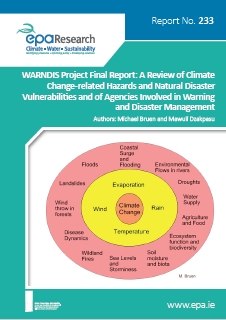
Research 233: WARNDIS Project Final Report: A Review of Climate Change-related Hazards and Natural Disaster Vulnerabilities and of Agencies Involved in Warning
Authors: Michael Bruen and Mawuli Dzakpasu, March 2018
Year: 2018
The purpose of this study was to identify and review the main types of natural disasters that may be impacted by anticipated climate change; identify the key agencies involved; assess their roles and capabilities; and identify existing and new potential data streams to assist with warning and disaster management.
Research 242: HOMERUN: Relative Homogenisation of the Irish Precipitation Network
Authors: John Coll, Mary Curley, Séamus Walsh and John Sweeney, March 2018
Year: 2018
Long instrumental records are rarely, if ever, homogeneous and most decade-to-century-scale time series of atmospheric data have been affected by changes caused by climatic and/or non-climatic factors. Nevertheless, accurate climate data are a prerequisite for basing climate-related decision-making on, and quality-controlled homogenised climate data are becoming integral to efforts across many countries to deliver climate services.
Research 241: Research of Upcycling Supports to Increase Re-use, with a Focus on Waste Electrical and Electronic Equipment (UpWEEE)
Authors: Michael Johnson, Kathleen McMahon and Colin Fitzpatrick, March 2018
Year: 2018
This report provides a range of recommendations aimed at supporting preparation for re-use of waste electrical and electronic equipment (WEEE) that will support the extension and development of this activity in Ireland.
Research 240: Technologies for Monitoring, Detecting and Treating Overflows from Urban Wastewater Networks
Authors: David Morgan, Liwen Xiao and Aonghus McNabola, March 2018
Year: 2018
In Ireland, most urban areas are drained by combined sewer systems, which convey wastewater and stormwater in a single pipe. During rainfall the capacity of combined sewers may be exceeded, leading to untreated discharges to receiving waters via storm water overflows (SWOs), which are a source of microbial pathogens.
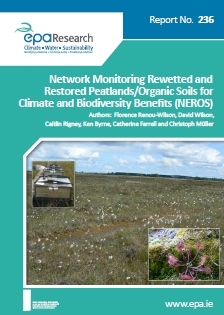
Research 236: Network Monitoring Rewetted and Restored Peatlands/Organic Soils for Climate and Biodiversity Benefits (NEROS)
Authors: Florence Renou-Wilson, David Wilson, Caítlin Rigney, Ken Byrne, Catherine Farrell and Christoph Müller, February 2018
Year: 2018
Ireland contains large areas of peatlands that constitute some of the most ecologically diverse habitats in the country. In natural peatlands, permanently waterlogged conditions prevent the complete decomposition of dead plant material leading to the accumulation of carbon rich peat. However, less than 20 % of the original peatland area is considered to be worthy of conservation.
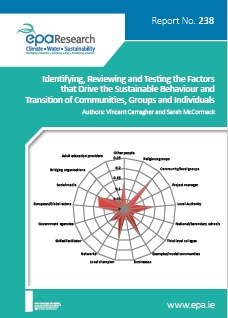
Research 238: Identifying, Reviewing and Testing the Factors that Drive the Sustainable Behaviour and Transition of Communities, Groups and Individuals
Authors: Vincent Carragher and Sarah McCormack, February 2018
Year: 2018
This research critically reviewed community interventions and sustainable-behaviour change programmes identifying drivers (enablers) adopted by those interventions. The aim was to distinguish key characteristics of success while also identifying barriers to sustainable transition and change.
Research 237: Integrated Indicators for Ireland: Adjusting Economic Progress for Environmental and Social Sustainability (I3: AEPESS)
Authors: Eleanor Doyle and Mauricio Perez-Alaniz, January 2018
Year: 2018
Decoupling economic growth from environmental quality is an imperative for Ireland, as with other modern developed economies. Not only has economic growth been linked with environmental sustainability impacts, but more recently social sustainability has also been highlighted in terms of its relationship to, and impacts from, the economy.
Research 239: Valuing Ireland’s Coastal, Marine and Estuarine Ecosystem Services
Authors: Daniel Norton, Stephen Hynes and John Boyd, January 2018
Year: 2018
This technical report demonstrates the data sources and methods that can be used to estimate the value of a number of coastal and marine ecosystem service benefits.
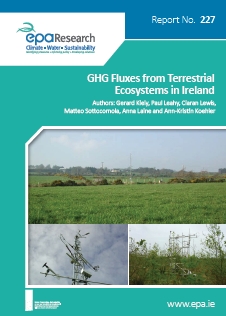
Research 227: GHG Fluxes from Terrestrial Ecosystems in Ireland
Authors: Gerard Kiely, Paul Leahy, Ciaran Lewis, Matteo Sottocornola, Anna Laine and Ann-Kristin Koehler, January 2018
Year: 2018
Irish grazed grasslands are a sink for carbon dioxide and a source for methane and nitrous oxide. Irish forests and pristine peatlands are sinks for carbon; however degraded peatlands are sources for carbon.
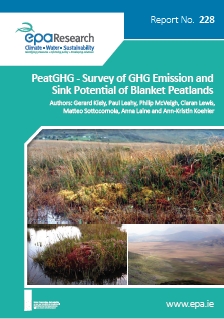
Research 228: PeatGHG - Survey of GHG Emission and Sink Potential of Blanket Peatlands
Authors: Gerard Kiely, Paul Leahy, Philip McVeigh, Ciaran Lewis, Matteo Sottocornola, Anna Laine and Ann-Kristin Koehler, January 2018
Year: 2018
Pristine peatlands are mostly sinks for carbon, while harvested or cut-away peatlands are sources of carbon. The principal pressures on Irish peatlands are associated with anthropogenic activities over the past few hundred years.
Research 235: Current Status and Potential Role of Eco-labels in Informing Environmentally Friendly Purchases and Behaviours
Authors: William Brazil, Brian Caulfield, December 2017
Year: 2017
Eco-labels are a widely used means of providing consumers with information regarding the environmental and energy impacts associated with various products and services. Given the opportunity that such labels represent, and the resources devoted to creating them, there is a need to ensure that they are effectively communicating the relevant information to the general public.
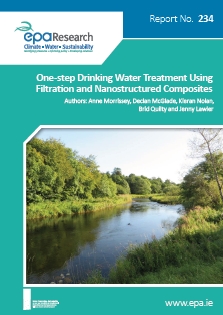
Research 234 - One-step Drinking Water Treatment Using Filtration and Nanostructured Composites
Authors: Anne Morrissey, Declan McGlade, Kieran Nolan, Brid Quilty and Jenny Lawler, December 2017
Year: 2017
This report provides a summary of the findings of the research on the design, development and testing of a novel drinking water treatment system using a combination of filtration and nanostructured composites for the removal of inorganic, organic and microbiological contaminants from water.
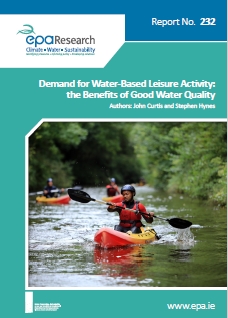
Research 232: Demand for Water-Based Leisure Activity: the Benefits of Good Water Quality
Authors: John Curtis and Stephen Hynes, November 2017
Year: 2017
The objective of this research was to determine how water-based recreational activities in Ireland are affected by differences in water quality across recreational sites.
Research 231: Assessment of Natural Organic Matter (NOM) and Ptaquiloside in Irish Waters
Authors: Connie O’Driscoll, Liwen Xiao, Xinmin Zhan, Bruce Misstear and Francesco Pilla, November 2017
Year: 2017
Ireland has an unacceptably high number of drinking water supplies that exceed the parametric value of 100 μg L-1 for total trihalomethanes (THMs) and has been reporting the highest non-compliance with respect to total THMs in drinking water across the 27 EU Member States.
Research 230: Sediment Flux – Measurement, Impacts, Mitigation and Implications for River Management in Ireland
Authors: Michael Bruen, Anna Rymszewicz, John O’Sullivan, Jonathan Turner, Damian Lawler, Elizabeth Conroy and Mary Kelly-Quinn, November 2017
Year: 2017
The SILTFLUX project addressed three major objectives related to sediment pollution in rivers.